1 billion diagnoses: Is it depression or hidden withdrawal? (PAWS)
Disclaimer: The information in this article is for educational and self-optimization purposes only and does not substitute for professional medical advice or clinical diagnosis. If you are experiencing severe, life-threatening symptoms or active suicidal thoughts, seek emergency medical attention immediately (Call 911 in the US or 999 in the UK).
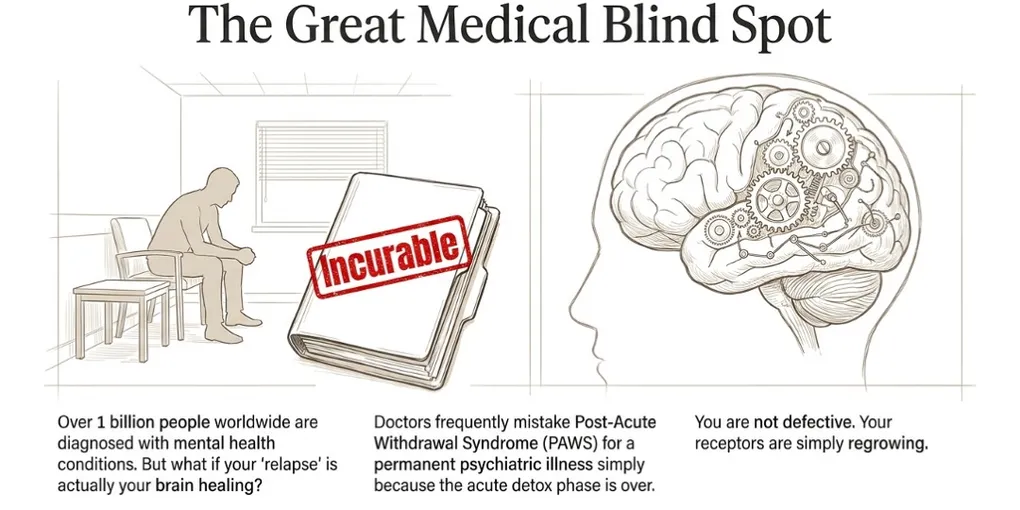
According to the World Health Organization (WHO), more than 1.1 billion people worldwide are currently living with a diagnosed mental health condition. That is nearly 1 in every 7 people on the planet.
Does this sound familiar to you? Perhaps you have spent months struggling with an unexplainable, suffocating wave of anxiety. Perhaps you wake up at 3:00 AM with your heart pounding out of your chest, only for your doctor to label it as “Generalized Anxiety Disorder” or “Panic Disorder.” Or maybe you have sunk into a dark, colorless apathy where nothing brings you joy, leading a doctor to write a prescription for “Treatment-Resistant Depression.”
In these moments, an icy wave of fear and guilt takes over: “I am defective. My brain is broken. I will be mentally ill for the rest of my life.”
Please take a deep breath and listen carefully: You are not defective, you are not crazy, and you do not have an incurable character flaw.
A massive portion of this “1 billion mentally ill” population is actually going through a completely physical, scientifically explainable, and 100% reversible biological process: hidden Post-Acute Withdrawal Syndrome (PAWS) or Tolerance Withdrawal.
Let’s break down how modern medicine frequently confuses the healing of brain receptors with permanent psychiatric illness—and why your condition is not a life sentence, but a solvable biological puzzle.
The great medical blind spot: How withdrawal is misdiagnosed as “new illness”
In everyday medical practice, a massive blind spot exists. While doctors are well-trained in managing acute detox or short-term crises, conventional medicine often fails to recognize what happens to the central nervous system during months 2, 6, or 12 of neuro-recovery.
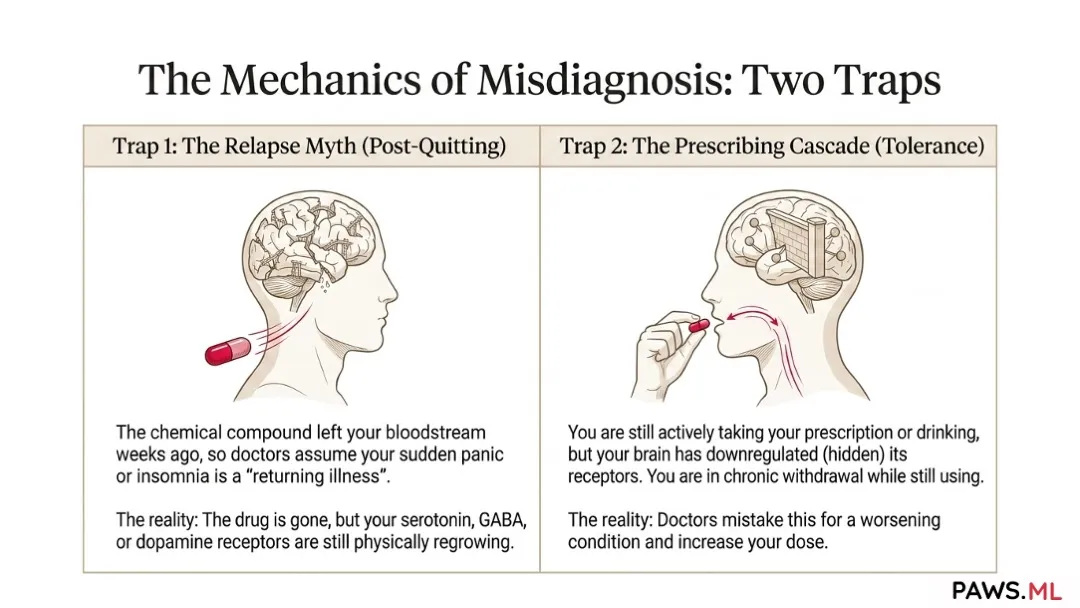
As a result, millions of people fall into two common medical traps:
Trap #1: PAWS after quitting (the “relapse myth”)
 You made a brave choice. You stepped away from alcohol, vaping/smoking, prescription sleeping aids, benzodiazepines (Xanax, Klonopin), or SSRI antidepressants (Lexapro, Zoloft). A month or two passed. The chemical compound left your bloodstream weeks ago.
Suddenly, a severe wave of insomnia, panic, or brain fog hits you. You visit your doctor, and they say: “The medication left your body weeks ago. Therefore, this must be your original mental illness returning. You are chronically ill and need to take heavy medication for life.”
This is a profound medical error. The drug is gone from your blood, but your serotonin, GABA, or dopamine receptors are still physically regrowing. This is not a relapse of a disease; it is Post-Acute Withdrawal Syndrome (PAWS).
You made a brave choice. You stepped away from alcohol, vaping/smoking, prescription sleeping aids, benzodiazepines (Xanax, Klonopin), or SSRI antidepressants (Lexapro, Zoloft). A month or two passed. The chemical compound left your bloodstream weeks ago.
Suddenly, a severe wave of insomnia, panic, or brain fog hits you. You visit your doctor, and they say: “The medication left your body weeks ago. Therefore, this must be your original mental illness returning. You are chronically ill and need to take heavy medication for life.”
This is a profound medical error. The drug is gone from your blood, but your serotonin, GABA, or dopamine receptors are still physically regrowing. This is not a relapse of a disease; it is Post-Acute Withdrawal Syndrome (PAWS).
Trap #2: PAWS before quitting (the prescribing cascade)
 This state is even more insidious. You are still actively taking your daily prescription, drinking your evening glass of wine, or hitting your vape.
However, your brain has downregulated (hidden) its receptors to protect itself from overstimulation. Your normal dose no longer brings an ounce of relief. Instead, your body enters a state of continuous, chronic withdrawal while you are still using. Unaware of this Tolerance Withdrawal, doctors often mistake it for a “worsening psychiatric condition” and increase your dosage or add a second medication—locking you into a dangerous prescribing cascade.
This state is even more insidious. You are still actively taking your daily prescription, drinking your evening glass of wine, or hitting your vape.
However, your brain has downregulated (hidden) its receptors to protect itself from overstimulation. Your normal dose no longer brings an ounce of relief. Instead, your body enters a state of continuous, chronic withdrawal while you are still using. Unaware of this Tolerance Withdrawal, doctors often mistake it for a “worsening psychiatric condition” and increase your dosage or add a second medication—locking you into a dangerous prescribing cascade.
Translating psychiatric labels into plain neuroscience
To stop fearing terrifying medical labels, let’s translate them into the simple language of neurochemistry:
Frightening Psychiatric Label ➔ What Is Actually Happening in Your Neurons
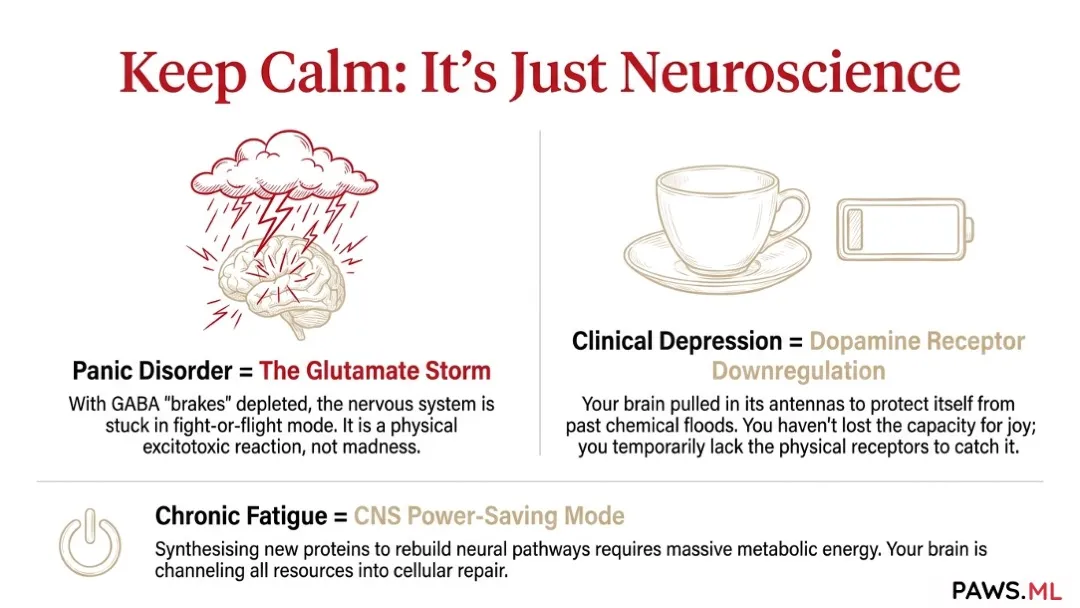
”Clinical Depression & Anhedonia” ➔ Dopamine Receptor Downregulation
Your brain isn’t “broken.” To protect itself from past chemical floods, it temporarily pulled in its dopamine antennas. You haven’t lost the capacity for joy; your brain simply lacks the physical receptors to catch natural dopamine right now.
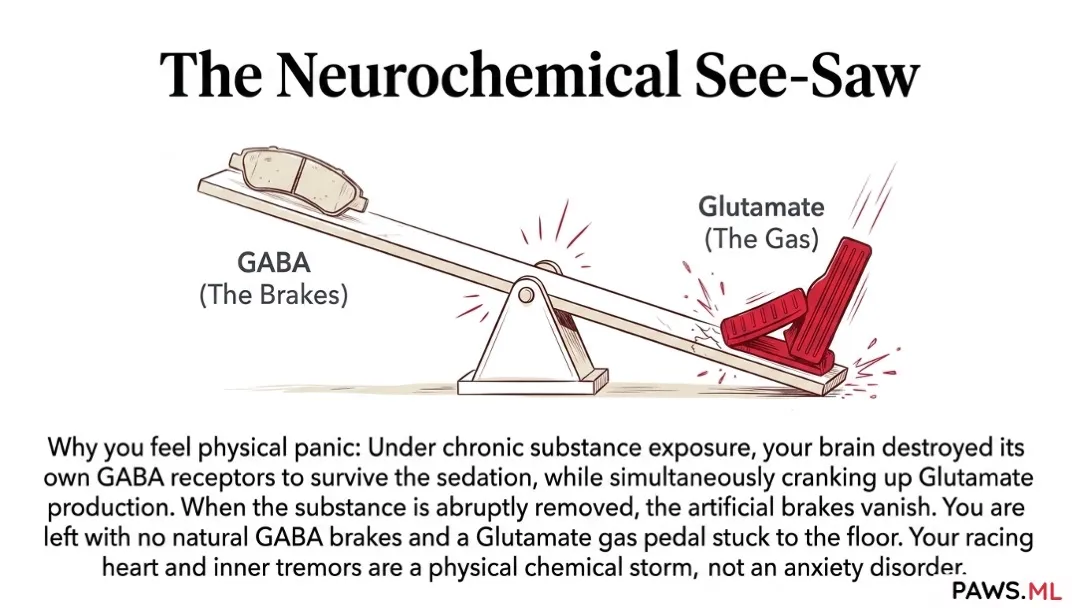
”Panic Disorder & Health Anxiety” ➔ The Glutamate Storm
Your heart is pounding at night not because you are going crazy, but because your GABA receptors (the brain’s natural brakes) are depleted. With no brakes, the gas pedal (Glutamate) is stuck to the floor, triggering a physical fight-or-flight response.
”ADHD-like Apathy & Chronic Fatigue” ➔ CNS Power-Saving Mode
Synthesizing new proteins to rebuild neural pathways requires massive metabolic energy. Your brain shuts down non-essential motivation to channel all resources into cellular repair.
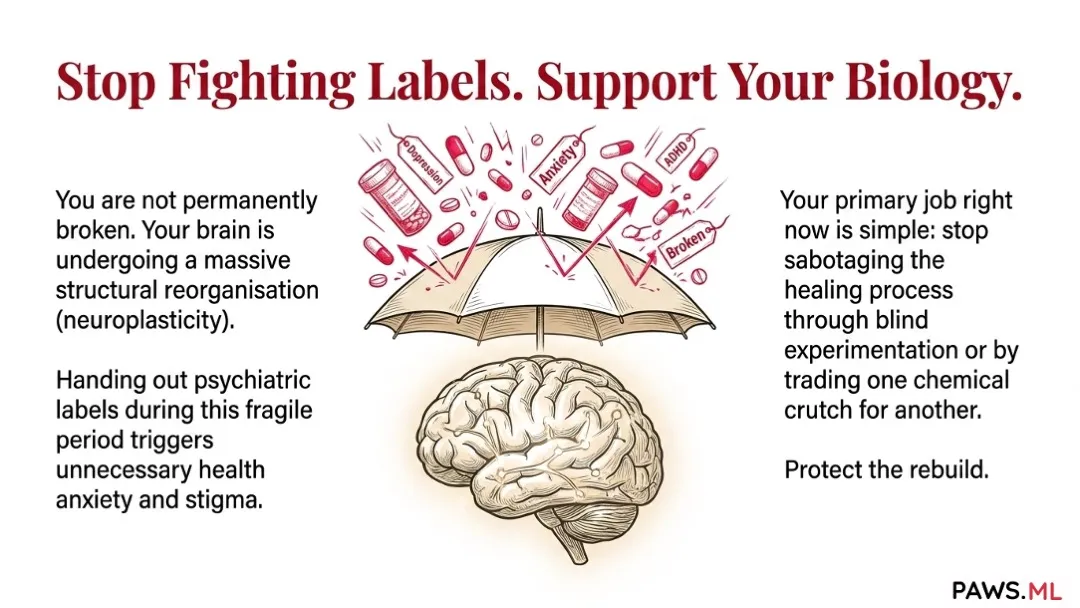
Stop fighting labels. Start supporting your biochemistry.
Being handed a psychiatric diagnosis or worrying about “addiction” often triggers severe health anxiety, social shame, and fear of career consequences.
However, once you realize that behind your panic or apathy lies a specific, measurable imbalance of GABA, Glutamate, or Dopamine, fear gives way to a clear, actionable roadmap.
You are not broken. Your brain is currently undergoing a massive structural reorganization (neuroplasticity). Your primary job right now is simply to stop sabotaging the process through blind experimentation or trading one chemical crutch for another.
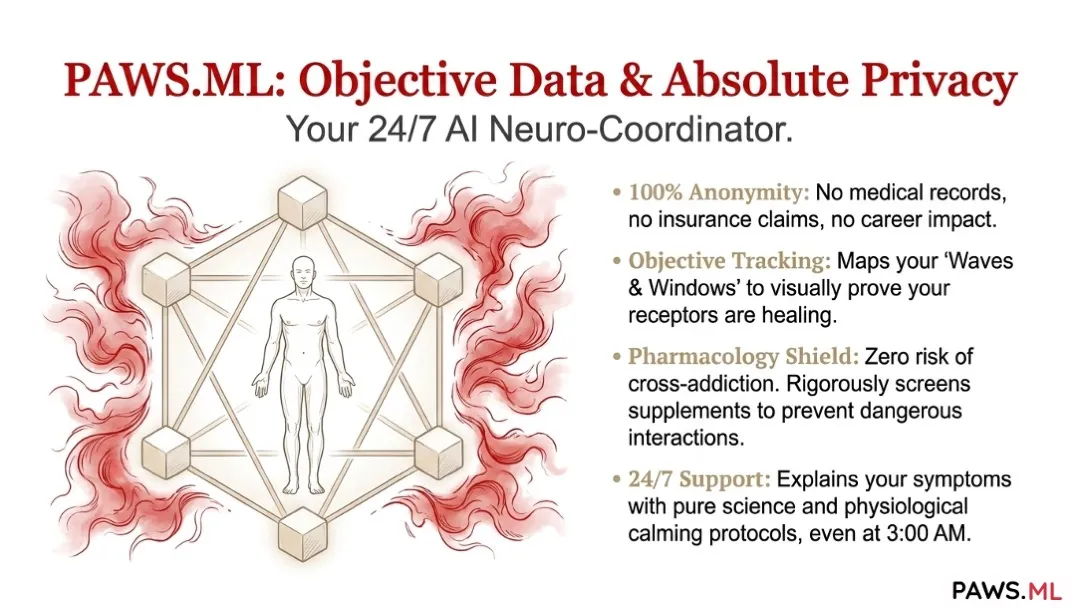
That is why we built PAWS.ML — an anonymous, AI-driven system designed to evaluate your health not through medical labels, but through the objective lens of neuro-recovery:
- 🔒 100% Anonymity & Freedom from Stigma: No medical insurance claims, no intrusive appointments, no fear of career impact. You interact with an expert AI on your own terms with complete data privacy.
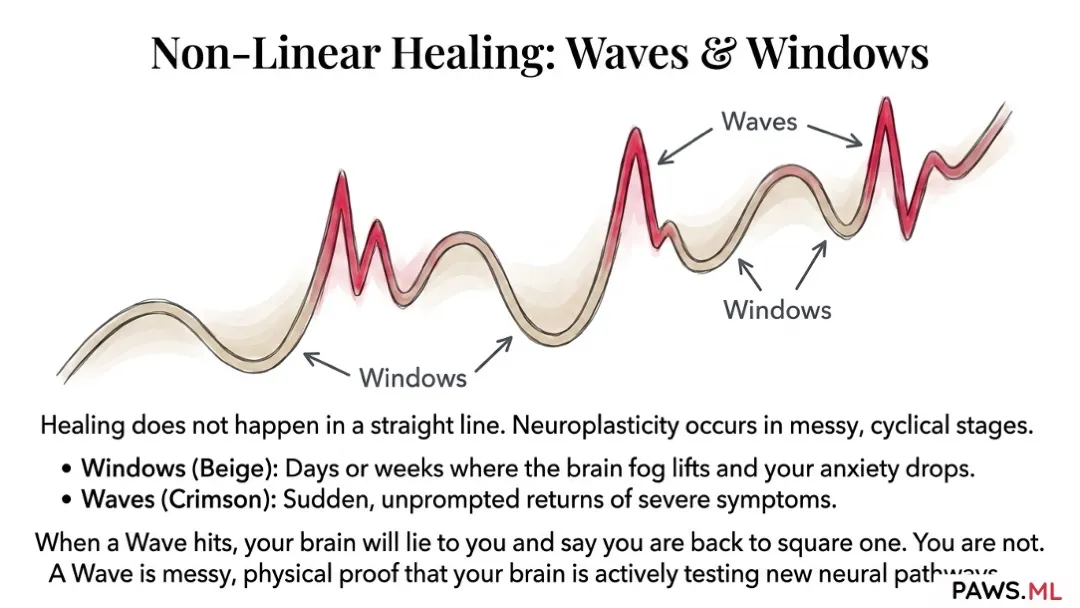
- 📊 Objective “Waves & Windows” Tracking: Our AI maps your daily symptoms, proving to you visually that your dopamine and GABA receptors are repairing—even on bad days when your anxious mind tells you otherwise.
- 🛡️ Pharmacology Safety Shield: Many people try to “fix” anxiety with dangerous internet supplements or OTC sedatives, causing severe cross-addiction. Our AI rigorously screens every supplement and amino acid against your active prescriptions, enforcing a strict 0% risk of new dependency.
- 💬 24/7 AI Coordinator: Available at 3:00 AM when health anxiety spikes, explaining the exact biological cause of your symptoms in seconds and guiding you through physiological calming protocols.
Remove the weight of guilt and fear. Your brain possesses a remarkable, proven capacity to heal itself.
3 safety rules to help your brain restore balance
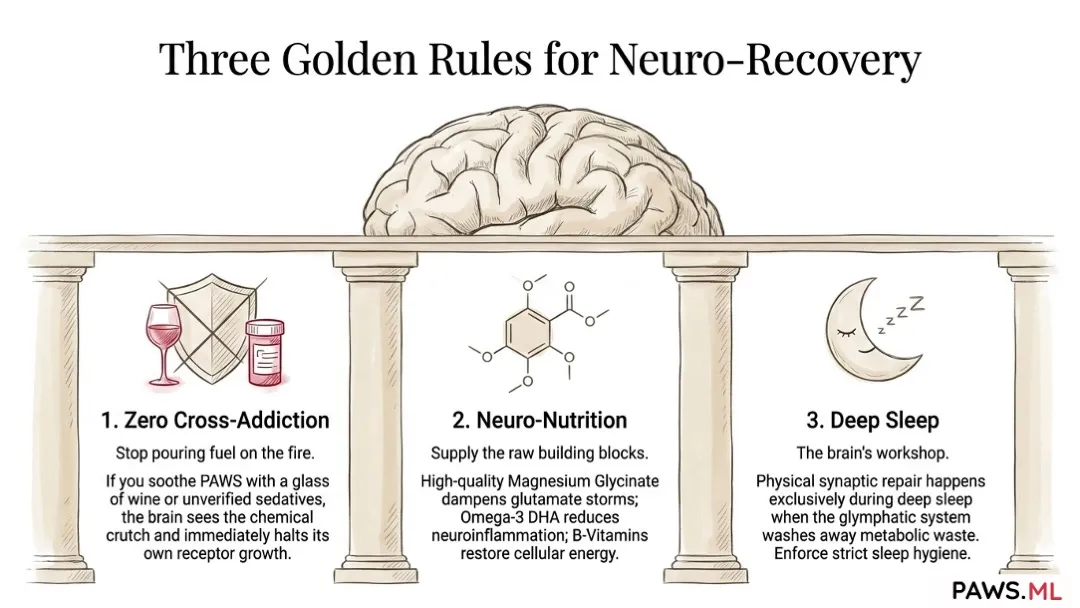
While your AI system constructs your personalized recovery profile, implement these three fundamental rules to accelerate receptor regrowth:
1. Stop pouring fuel on the fire (zero cross-addiction)
This is the most critical rule. If you attempt to soothe PAWS anxiety with a glass of wine, prescription sleeping pills, or unverified herbal sedatives, you reset the clock. Your brain sees the chemical crutch and immediately halts the growth of its own GABA receptors. Relieve symptoms using physical and biological methods only.
2. Supply raw building blocks (neuro-nutrition)
To build new receptor proteins, your brain requires raw materials. High-quality Magnesium Glycinate helps dampen glutamate storms, Omega-3 Fatty Acids (DHA) reduce neuroinflammation, and B-Complex Vitamins (especially B1) restore cellular energy to starved neurons. (Always verify dosages and drug compatibility via PAWS.ML or your physician).
3. Treat sleep as your primary neuro-workshop
Your brain does not repair receptors while you are awake and stressed. Physical synaptic repair happens exclusively during deep sleep when the glymphatic system washes away metabolic waste. Practice strict sleep hygiene: complete bedroom darkness, cool room temperatures, and zero screen light 2 hours before bed.
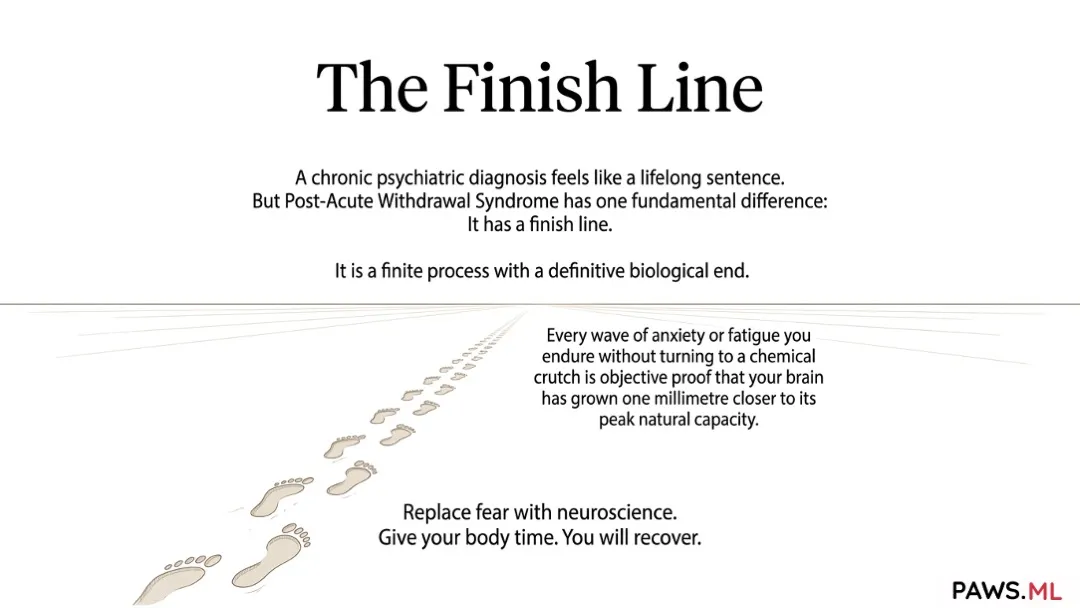
Conclusion: Your recovery has a finish line
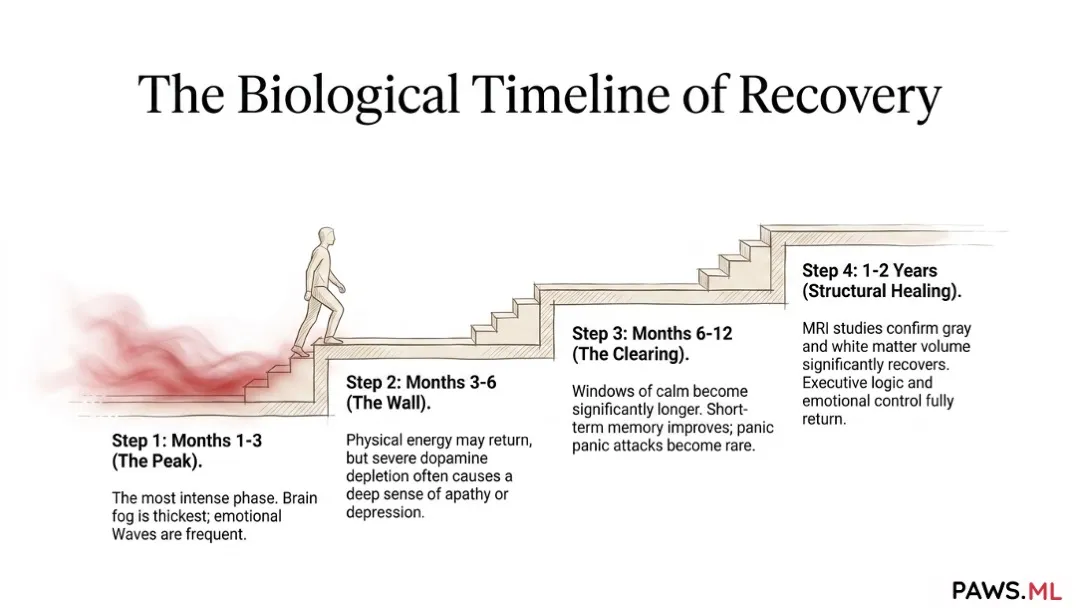
A chronic psychiatric diagnosis sounds like a lifelong sentence. But Post-Acute Withdrawal Syndrome and Tolerance Withdrawal have one fundamental difference: THEY HAVE A FINISH LINE.
Pre-PAWS during active use (tolerance) can torment you for years, slowly eroding your quality of life.
Post-PAWS in sobriety consists of temporary “growing pains.” It is a finite process with a definitive biological end.
Every wave of anxiety or fatigue you endure without turning to a chemical crutch is physical, objective proof that your brain has grown another millimeter closer to its natural, peak capacity. Replace fear with neuroscience, track your progress objectively, and give your body the time it needs. You will recover.
If you are currently experiencing the challenges of Post-withdrawal syndrome, return to our main page to explore how our AI recovery assistant can help stabilize your neurochemistry.