No energy after quitting Adderall or stimulants? PAWS guide
Zero motivation weeks after quitting stimulants: Why you can’t get out of bed
Disclaimer: The information in this article is for educational purposes only and does not substitute for professional medical advice. If you are experiencing severe, debilitating depression or suicidal thoughts, please contact your healthcare provider or emergency services immediately.
You made the difficult decision to stop taking stimulants. Whether it was prescription ADHD medication like Adderall, Vyvanse, Ritalin, or illicit stimulants like cocaine, you survived the initial “crash.” You slept for days, ate everything in sight, and got through the physical detox.
You probably thought that after a month, your natural energy would return and you could get back to work. But instead, you are facing a terrifying new reality: you have absolutely no drive to do anything.
You wake up feeling like your limbs are made of lead. You drink three cups of coffee, only to end up staring blankly at a wall. The dirty dishes are piling up, work emails are going unanswered, and you feel entirely emotionally numb. You might be Googling “no energy 1 month after quitting Adderall” while a voice in your head whispers: “Have I permanently lost my drive? Am I just a lazy person now?”
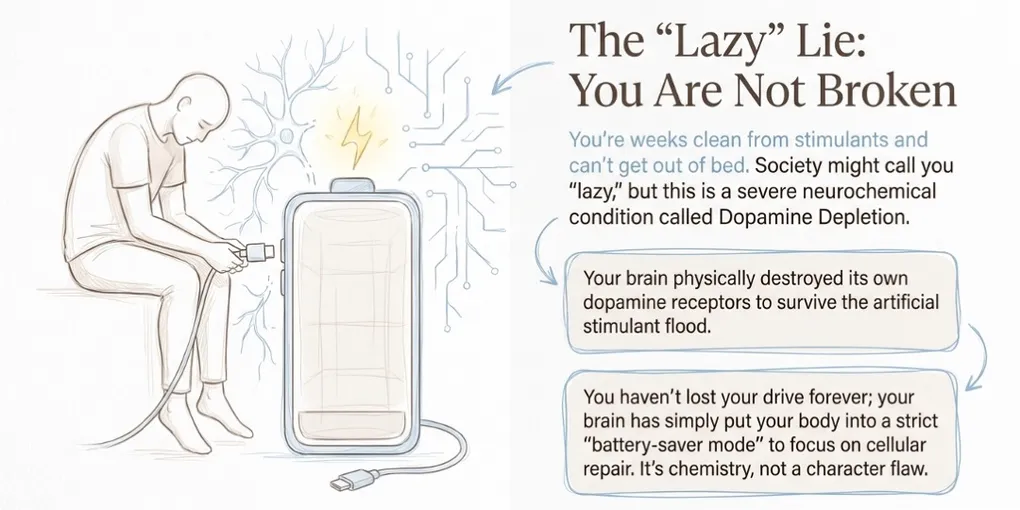
Please, listen carefully: You are not lazy, and your drive is not gone forever.
Having zero motivation after quitting stimulants is not a character flaw. It is a severe, documented neurochemical condition known as Dopamine Depletion, a core symptom of Post-Acute Withdrawal Syndrome (PAWS). Let’s explore exactly why you can’t get out of bed, how long this will last, and how to safely navigate your recovery.
The neuroscience: What stimulants did to your dopamine receptors
To understand why you feel like an empty shell, you need to look at what stimulants actually do to the brain.
Stimulants work by forcing your brain to dump massive, unnatural amounts of dopamine (the neurotransmitter responsible for motivation, reward, and energy) into your neural synapses. It made you feel focused, driven, and invincible.
But your brain is designed to maintain balance (homeostasis). To protect itself from being overwhelmed by this constant chemical flood, your brain did something drastic: it downregulated (turned off and removed) a huge portion of its own dopamine receptors.
The dopamine vacuum
Now that you have stopped taking the stimulant, the artificial flood of dopamine is gone. But your brain still has a critically low number of receptors.
Normally, the prospect of getting a paycheck, seeing a friend, or taking a walk releases enough natural dopamine to make you act. Right now, because of your depleted receptors, those normal joys do not even register in your brain. This creates a state of anhedonia (the biological inability to feel pleasure) and PAWS extreme fatigue. Your brain has literally put your body into “battery-saver mode.”
The biohacking trap: Why “pushing through” is dangerous
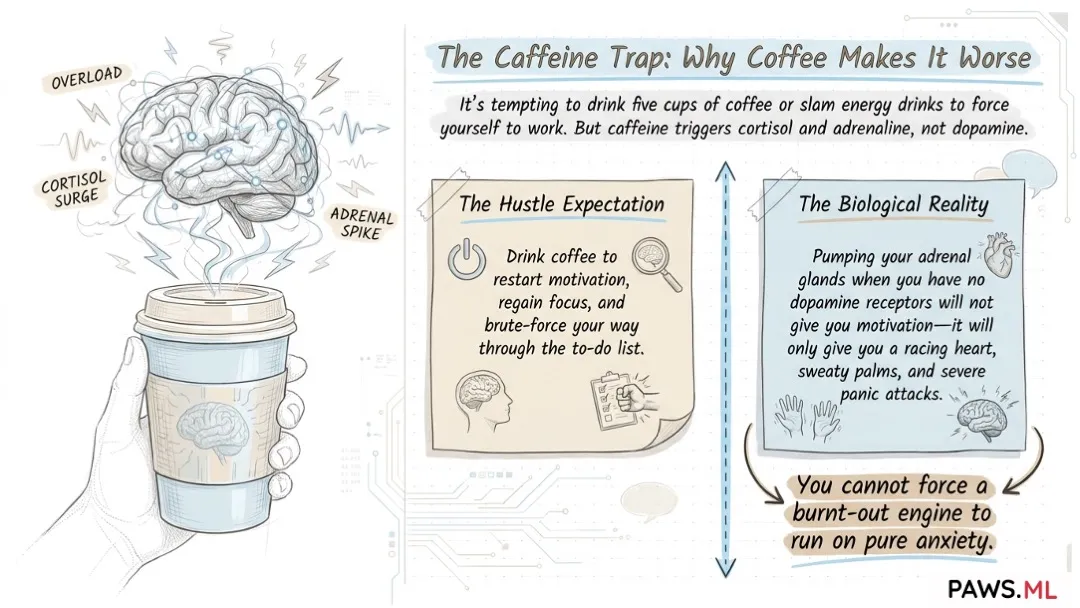
When you are terrified of losing your job or failing your classes because of this profound apathy, desperation takes over. Many people turn to Reddit forums looking for a “magic pill” to fix their dopamine depletion recovery.
They start buying massive doses of L-Dopa, Mucuna Pruriens, heavy pre-workout powders, or aggressive nootropics to “hack” their energy levels back to normal.
This can cause catastrophic damage to your recovery. Aggressively stimulating an exhausted nervous system does not build new receptors; it just whips a tired horse. This can lead to severe adrenal fatigue, heart palpitations, and crushing anxiety. Even worse, if you are currently taking other medications—like antidepressants (SSRIs) or blood pressure pills—mixing them with heavy dopamine boosters can trigger dangerous drug interactions.
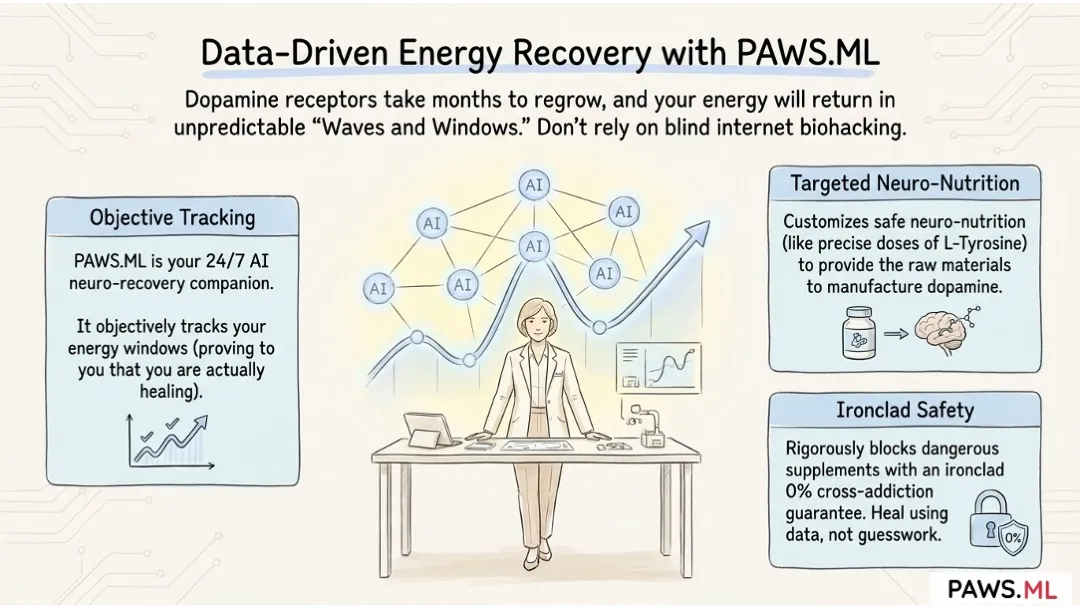
Recovering your dopamine system requires microsurgical precision, not blind internet experiments. That is why we built PAWS.ML — your secure, AI-driven neuro-recovery companion:
- 📉 Motivation & Energy Tracker: When you lack dopamine, your brain physically cannot process “progress,” making you feel like you are failing. Our AI tracks your symptoms daily, providing objective data that your “Windows” of energy are actually increasing month over month.
- 🛡️ Pharmacology Safety Agent: Before you take any supplement to boost your energy, our AI rigorously cross-checks it against your current medications to prevent dangerous interactions.
- 💊 Safe Neuro-Nutrition: Recommends precise, safe amino acids to support your brain with one ironclad rule: 0% cross-addiction risk.
- 💬 AI Coordinator: An empathetic digital companion that reminds you that your “laziness” is just chemistry, adapting your recovery protocol as your energy slowly returns.
Don’t burn out your remaining receptors with dangerous biohacking. Let an intelligent, medically secure AI agent guide your healing.
👉 Track your energy levels and get a safe recovery plan with PAWS.ML)
The recovery timeline: When will your energy return?
The most burning question is always: how long to get energy back after quitting Adderall or other stimulants?
While the adderall withdrawal fatigue timeline varies depending on your dose and how long you used the substance, neurobiology gives us a standard roadmap of “Waves and Windows”:
- Days 1 to 14 (The Crash): Extreme hypersomnia (sleeping 12-14 hours a day), ravenous hunger, and physical exhaustion. The drug is leaving your system.
- Weeks 2 to 8 (The Wall of Apathy): You are physically awake, but mentally paralyzed. Motivation is at absolute zero. This is the peak of dopamine depletion, and sadly, where most people relapse because they need to “get things done.”
- Months 2 to 6 (The Awakening): You will begin to experience “Windows” of energy. You might find you have the motivation to work solidly for 2 or 3 hours a day before the fatigue rolls back in (a “Wave”).
- Months 6 to 12+ (Upregulation): Your brain successfully builds new dopamine receptors. Your natural drive, your ability to focus without a pill, and your capacity to enjoy small things return fully.
4 safe protocols to rebuild dopamine without relapsing
You cannot force your receptors to grow overnight, but you can create the perfect biological environment for them to heal. Here are 4 safe ways to manage anhedonia stimulant withdrawal:
1. Beware the caffeine & nicotine trap
It is tempting to drink five cups of coffee or chain-smoke just to feel something. However, caffeine works primarily by triggering adrenaline and cortisol, not dopamine. Pumping your adrenal glands when you have no dopamine receptors will not give you motivation; it will only give you a racing heart, sweaty palms, and severe anxiety. Limit your caffeine intake to protect your adrenal health.
2. Safe precursors (l-tyrosine)
Your brain needs the raw materials to manufacture its own dopamine naturally. L-Tyrosine for adderall withdrawal is widely researched. It is an amino acid found in food that acts as a direct building block for dopamine. However, the dosage and timing must be correct, and it must be cross-checked with any other medications you take. (Always consult your doctor or the PAWS.ML pharmacology agent before starting).
3. Behavioral activation (micro-dosing dopamine)
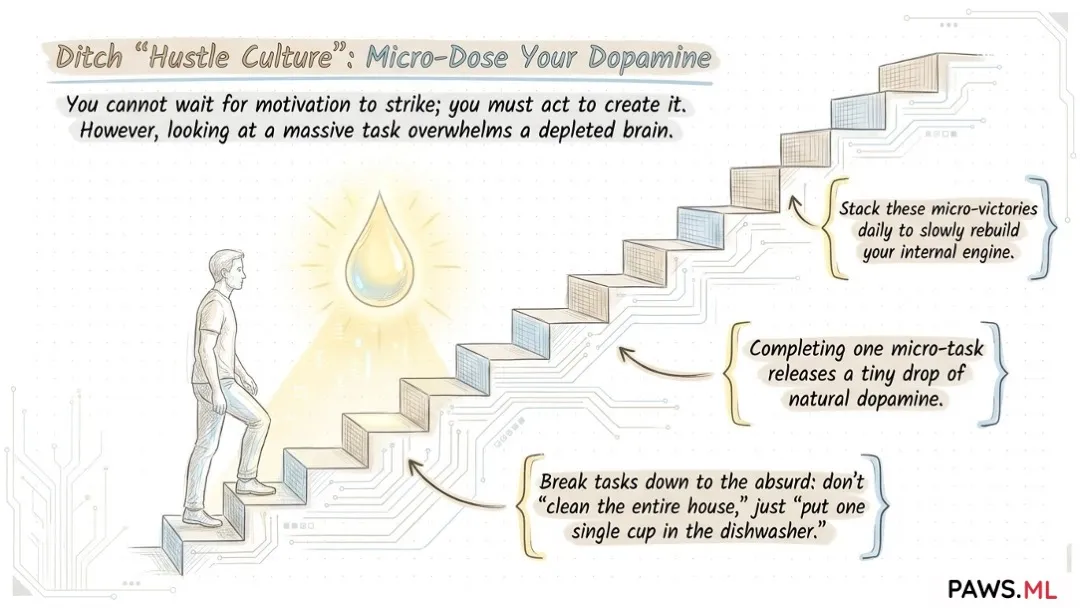
You cannot wait for motivation to strike before you act; you must act to create motivation. Right now, looking at a big task (like “clean the house” or “write a report”) overwhelms your depleted brain. You must break tasks down into ridiculously small micro-steps. Your goal isn’t to “clean the house”; your goal is to “put one cup in the dishwasher.” Completing that one micro-task releases a tiny drop of natural dopamine. Stack these micro-victories to build momentum.
4. The role of sleep in receptor repair
Your dopamine receptors do not repair themselves while you are awake and stressed. The physical rebuilding of neural pathways happens during deep, restorative sleep. Prioritize a strict sleep schedule, utilize dark therapy (no screens before bed), and allow your body the rest it is begging for.
Conclusion & when to seek clinical help
Your drive, your passion, and your personality are not gone. They have simply taken a temporary leave of absence while your brain repairs the damage caused by hyper-stimulation. Treat yourself with the same grace and patience you would offer a person recovering from a major physical surgery.
⚠️ Medical Red Flags: While PAWS-related fatigue and apathy are normal and can be managed effectively with tracking and safe nutrition, they should not be confused with acute psychiatric crises. Seek professional medical help immediately if your apathy turns into:
- An absolute inability to consume food or water for days;
- Severe, clinical depression that renders you entirely catatonic;
- Active suicidal ideation or thoughts that life without stimulants is no longer worth living.
For the heavy, frustrating fatigue of PAWS, patience is your ultimate cure. Keep going. The fog will lift, and your natural energy will return.
If you are currently experiencing the challenges of Prolonged withdrawal syndrome, return to our main page to explore how our AI recovery assistant can help stabilize your neurochemistry.