L-Tyrosine for PAWS and Burnout: Dopamine Biohacking or Placebo?
Disclaimer: The information in this article is strictly for educational purposes. If you are experiencing acute, life-threatening symptoms (seizures, delirium, active suicidal ideation), please seek emergency medical help immediately (e.g., dial 999 or go to A&E).
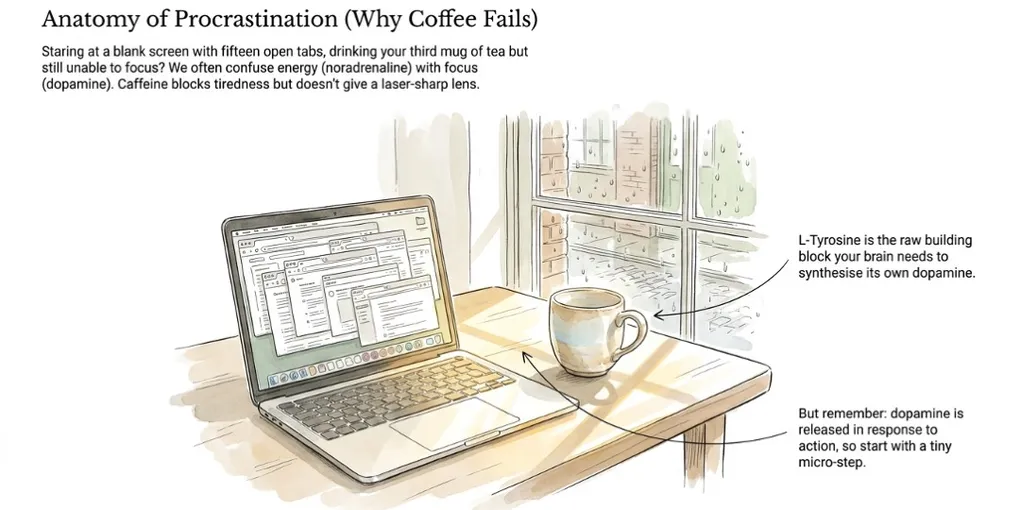
Picture a familiar scene: it’s the middle of the working day, a deadline is looming, and you’re just sitting there, staring at your monitor. You have 15 tabs open in your browser, you’re on your third cup of coffee, but your brain flatly refuses to pull your thoughts together. Your hand treacherously reaches for your phone to refresh your news feed for the hundredth time. You feel apathy, boredom, and a complete lack of drive.
In such moments of despair, many turn to the internet searching for a “Limitless pill” and inevitably stumble upon L-Tyrosine. Biohackers, software developers, and top executives hail this amino acid as the ultimate fuel for motivation and productivity.
But a fair question arises: can L-Tyrosine genuinely restore your laser focus and get you working? Or are all these rave reviews simply a placebo effect and a lucky set of circumstances?
Spoiler alert: the truth is far more interesting. L-Tyrosine isn’t magic; it’s rigorous neurobiology. And for it to work, you need to understand how the “factory” inside your head operates.
The Anatomy of Focus: How an Amino Acid Turns into Motivation
In everyday life, we often confuse the words “stamina” (having physical energy) and “focus” (the ability to direct that energy toward a single task).
Your ability to maintain attention and avoid being distracted by cat memes is governed by dopamine. It acts like a laser sight (or the “steering wheel” of your brain), assigning a “This is important!” marker to an otherwise tedious task. Meanwhile, noradrenaline (your “accelerator pedal”) is responsible for your energy and readiness to sit upright and type.
So, where does L-Tyrosine come in?
The fact is, L-Tyrosine itself is not a stimulant. It is simply the “raw material”—the building block from which your brain assembles the hormones you need on its internal assembly line, following a strict sequence:
L-Tyrosine ➔ L-Dopa ➔ Dopamine ➔ Noradrenaline ➔ Adrenaline
If you are in a state of apathy (for example, following severe stress, burnout, or quitting stimulants and excessive caffeine), your internal assembly line is empty. This is precisely why the task of writing a report feels like an insurmountable mountain—you experience “initiation friction”.
At this moment, taking L-Tyrosine provides your brain with the necessary raw material. However, there is a crucial psychological secret here: you cannot simply swallow a capsule and wait for motivation to magically descend upon you. Dopamine is released in response to action.
You must break the daunting task down into absurdly small micro-steps (for instance, “just open the document and type a single word”). Completing this micro-action forces your brain to take the supplied L-Tyrosine, synthesise a drop of dopamine, and reward you. A “spark” occurs, kick-starting your work momentum.
Science and Myths: Why Does Tyrosine Work for Some and Not for Others?
If you read reviews online, you’ll notice an odd phenomenon: one person claims L-Tyrosine changed their life and saved their career, whilst another complains the supplement acted like a “dud”.
For years, scientists struggled to understand this paradox until neurobiology provided a clear answer: L-Tyrosine is not a stimulant. It is a protective buffer.
The Secret of the “Closed Valve”
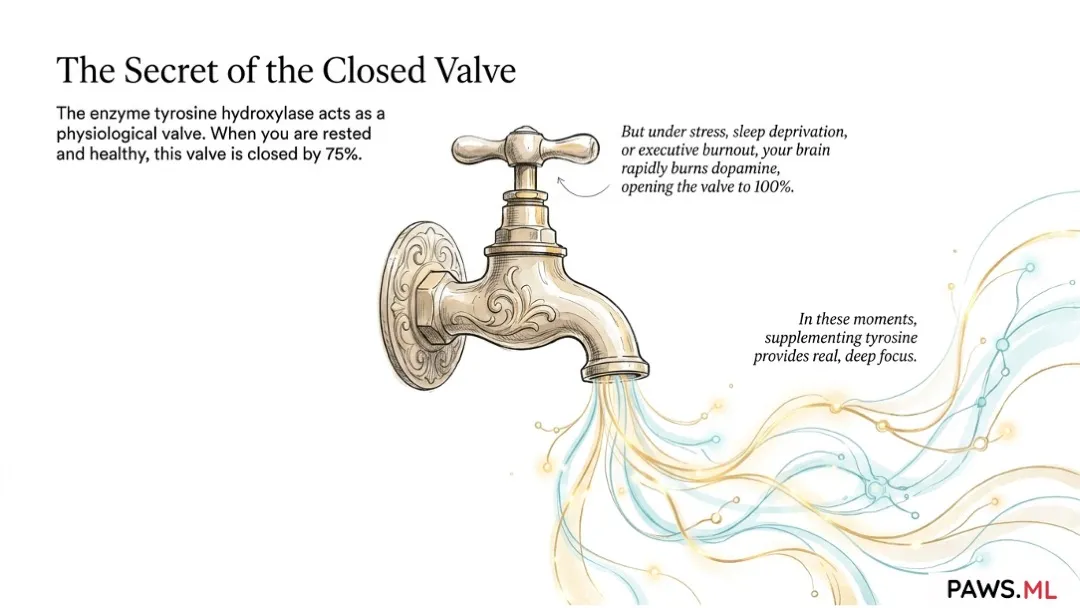
In our brain, there is an enzyme (tyrosine hydroxylase) that acts like a valve on a pipeline. When you are healthy, well-rested, sitting on a beach, and experiencing no stress—this valve is 75% full. The brain doesn’t need any more dopamine. If you take L-Tyrosine at this point, it simply passes straight through—the “valve” is closed, and the brain excretes the excess. This is why the supplement has almost no effect on rested individuals in a baseline state.
When Does L-Tyrosine Become a Superpower?
Everything changes under conditions of stress, sleep deprivation, intense cognitive workload, or multitasking.
During moments of peak stress, your neurons begin to “spark” wildly, rapidly depleting your reserves of dopamine and noradrenaline. Noticing the deficit, the brain tears off the seals and opens the “valve” to 100%. Now, the amount of dopamine you can produce depends on only one thing: whether there is L-Tyrosine in your bloodstream.
What Do the Clinical Trials Say?
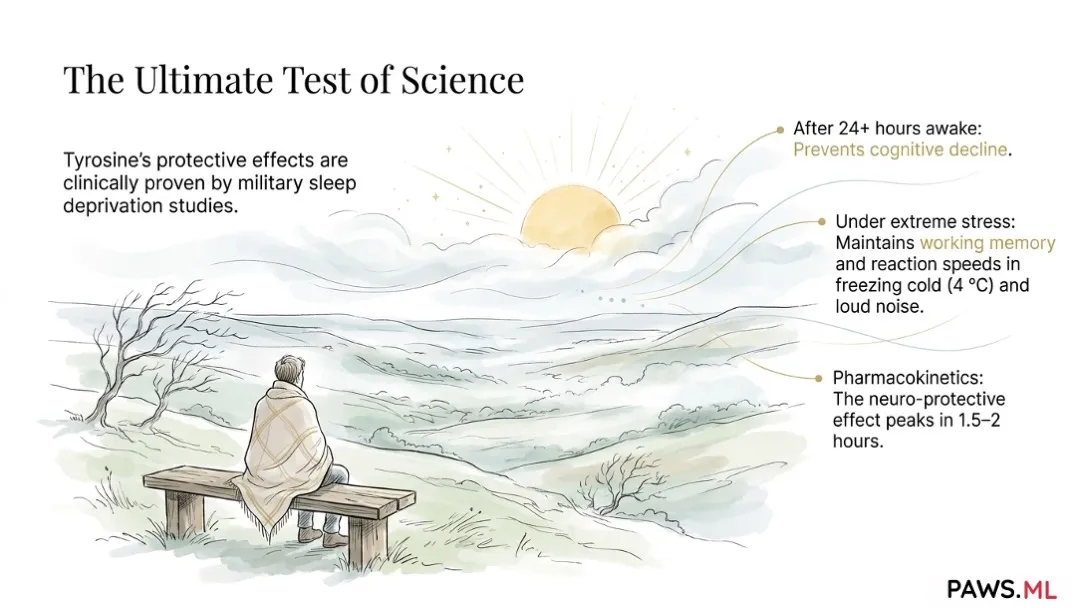
Military departments (specifically, the US Navy Aerospace Medical Research Laboratory) have conducted a series of rigorous, double-blind, placebo-controlled trials, subjecting personnel to extreme stress:
-
Sleep Deprivation: During night shifts following 24 hours without sleep, taking L-Tyrosine (at a dose of around 150 mg/kg) phenomenally reduced cognitive decline. Subjects missed far fewer crucial signals on monitors and maintained their reaction times, whereas the placebo group was literally “falling asleep” with their eyes open.
-
Extreme Conditions: When subjects were placed in cold environments (4 °C), hypoxic conditions (simulating an altitude of 4,700 m), or subjected to deafening noise (90 dB), L-Tyrosine completely mitigated memory deterioration and preserved focus at baseline levels.
-
Speed of Thought: Modern cognitive models have proven that a single 2-gram dose of tyrosine reduces the time the brain needs to make decisions, without any loss of accuracy. Furthermore, it improves reactive inhibition—meaning your ability to hit the brakes in time and avoid doing something impulsively stupid.
Important caveat: The protective effect of the supplement does not last all day. It peaks 1.5–2 hours after ingestion and fades after 3–4 hours.
The “Hacking” Manual: Limitations and Safety Rules
For L-Tyrosine to work as a powerful tool rather than just making for very expensive urine, neurobiologists recommend adhering to strict biohacking rules:
-
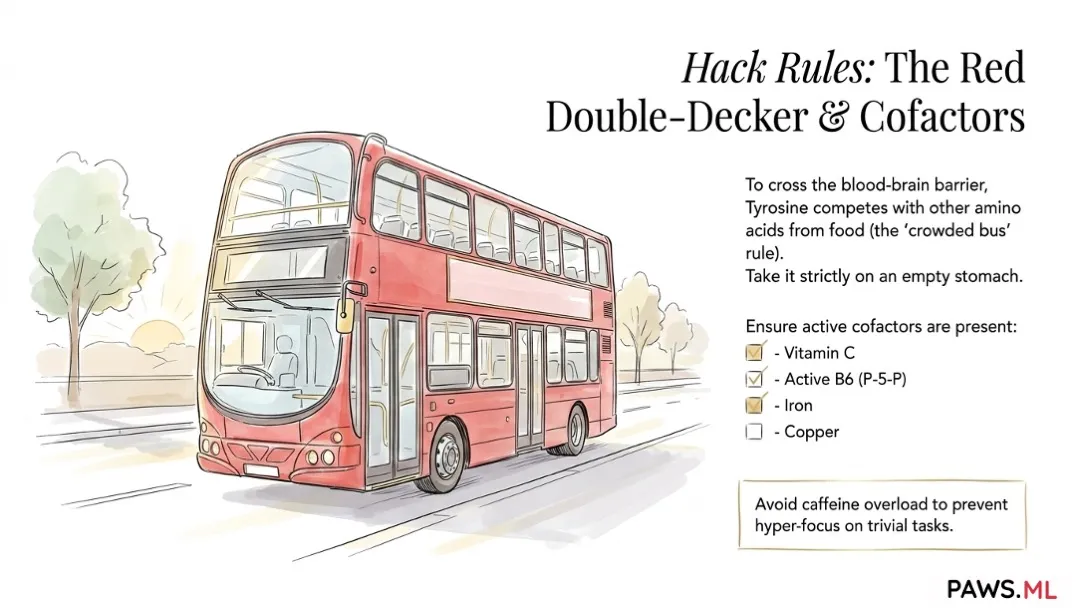
The Crowded Bus Rule (Take on an empty stomach): To get from the blood into the brain, L-Tyrosine must cross the blood-brain barrier using specific transporter proteins. The problem is that other amino acids from your food compete for seats on these very same “buses”. If you take tyrosine alongside a protein-heavy English breakfast, it simply won’t get on the bus. You must take the supplement strictly on an empty stomach (30–60 minutes before food).
-
A Factory Can’t Run Without Electricity (Cofactors): To convert the amino acid into dopamine, your body needs helpers: Vitamin C, B-vitamins (especially B6), copper, and iron. If you have a severe deficiency in these elements, the effect will be lacklustre.
-
Warning: The Risk of Compulsive Hyperfocus: If you mix L-Tyrosine with strong stimulants (e.g., a massive dose of caffeine), there is a risk that your dopamine will skyrocket too high. You will experience what is known as compulsive focus: instead of writing important code or an essential report, you’ll spend 4 hours perfectly concentrated on rearranging paperclips and sorting old emails.
Who Won’t Benefit from L-Tyrosine (Or Could Even Be Harmed):
Science requires objectivity, so it’s vital to understand the limitations:
-
The Age Paradox: Surprisingly, clinical tests have shown that in older adults (60–75 years), due to changes in liver metabolism, the supplement causes an overly sharp spike in tyrosine. This leads to an “overdose” effect and, through a feedback loop, actually worsens memory and concentration. (The effect follows an inverted U-shape—too much is just as bad as too little).
-
Clinical Diagnoses: L-Tyrosine is not a cure for ADHD (Attention Deficit Hyperactivity Disorder) or severe clinical depression. It also does not increase physical muscle endurance in the gym.
-
Strict Contraindications: The supplement is strictly prohibited for people with an overactive thyroid (Graves’ disease), those experiencing manic or paranoid states, and individuals taking MAOI antidepressants (due to the risk of a severe hypertensive crisis).
The Elephant in the Room: The Power of the Placebo Effect
So, you bought a bottle of L-Tyrosine, took a capsule on an empty stomach, and an hour later breezed through a complex project you’d been putting off for weeks. You’re thrilled! But the neurobiologist inside you must ask a sceptical question: “Was it really the amino acid? Or did my brain just believe in a magic pill?”
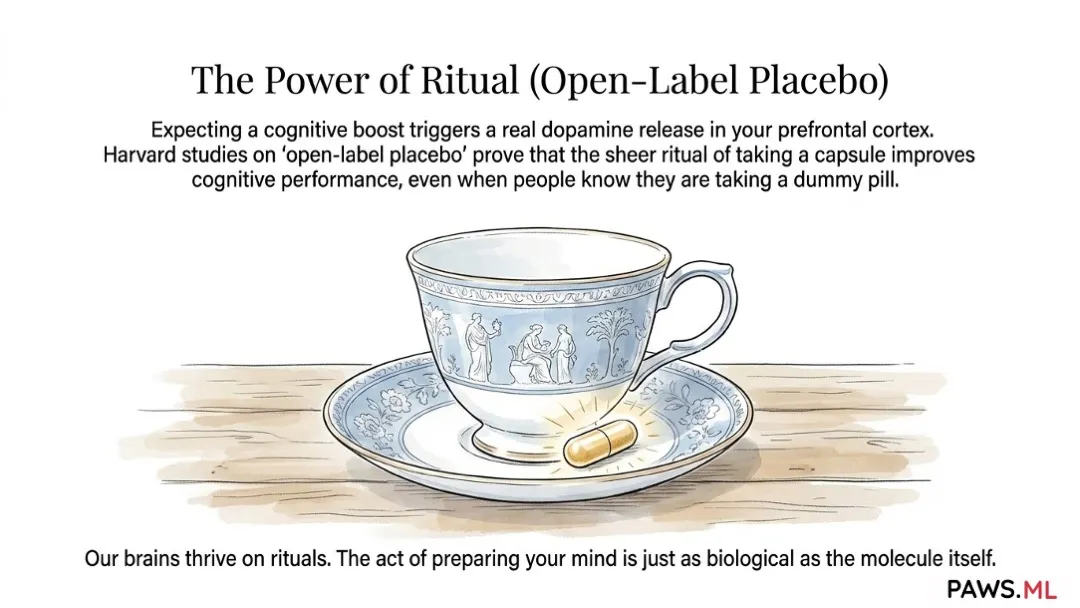
For years, the placebo effect was considered mere “autosuggestion” or an annoying nuisance in clinical trials. But modern science has proven: a placebo is not just in your thoughts; it is real physiology.
The expectation of success and the medical ritual itself (swallowing a pill, drinking water, checking the time) prompt the prefrontal cortex of your brain to command the release of real endogenous opioids (endorphins) and dopamine. Yes, you read that right: simply expecting L-Tyrosine to boost your dopamine actually causes your brain to start synthesising it!
The Paradox of the “Open-Label Placebo”
Recently, scientists at Harvard Medical School made a revolutionary discovery. They gave patients capsules with “DUD. NOTHING INSIDE” printed in large letters on the bottle. But the doctors added: “The very ritual of taking this pill triggers healing mechanisms”. And it worked! Even knowing they were swallowing chalk, patients showed improvements in cognitive and physical metrics. Our brains love rituals so much that they are willing to heal themselves.
So how can we tell where the genuine biochemical buffer of L-Tyrosine has worked, and where it’s just the brilliant self-deception of our own minds?
Information Noise: Why We Draw False Conclusions
The main problem with any DIY biohacking is the “dirty experiment”. Our bodies are a chaotic mix of hormones, stress, food, and circadian rhythms. Spotting the work of a single amino acid amidst this chaos is incredibly difficult.
Why Do We Often Confuse the Supplement’s Effect with Simple Coincidence?
-
Scenario A (The Sleep Factor): You took tyrosine, but the night before, for the first time in a month, you slept a solid 9 hours and had a brilliant breakfast. What gave you focus? The sleep that washed the toxins from your brain, not the capsule.
-
Scenario B (The Circadian Peak): You took the capsule at 9:00 am. By 10:30 am, you feel incredibly alert. The trick is that for most people, 10:00–11:00 am coincides with the natural daily peak of cortisol and maximum productivity.
-
Scenario C (Synergy with Caffeine): You washed your L-Tyrosine down with a strong espresso. The caffeine blocked your fatigue receptors (adenosine) and triggered an adrenaline rush. The coffee did all the heavy lifting, whilst tyrosine took the credit.
To avoid deceiving yourself, you need to stop evaluating the effect in terms of “I think I feel a bit better”. There will be no euphoria like you’d get from illicit stimulants. You need hard, measurable metrics.
Practicum: How to Run a Personal Test and See the Real Effect (Instructions)
L-Tyrosine is a precision instrument. It fixes the “steering wheel” (your focus), rather than endlessly expanding the “petrol tank” (your energy). To know if the supplement is genuinely working, try this test.
Step 1. Establish Your “Baseline of Failure” (Before Ingestion)
Sit in front of a blank piece of paper and honestly ask yourself: what exactly are you physically incapable of forcing yourself to do right now? How is your exhaustion manifesting?
Examples:
- “I haven’t been able to write the first sentence of this report for an hour.”
- “I can’t look at this spreadsheet for longer than 3 minutes—my hand unconsciously reaches for my phone.”
- “I am infuriated by the sound of someone else breathing or the ticking of the clock in the office.”
Write this down. This is your starting point.
Step 2. A Clean Start
Take L-Tyrosine strictly on an empty stomach, 40 minutes before food and coffee. Wait 1–1.5 hours for it to pass through the blood-brain barrier and for your enzymes to begin assembling dopamine. Begin taking micro-steps (open the necessary file, write the headline).
Step 3. Evaluation by Measurable Criteria (Where to Look)
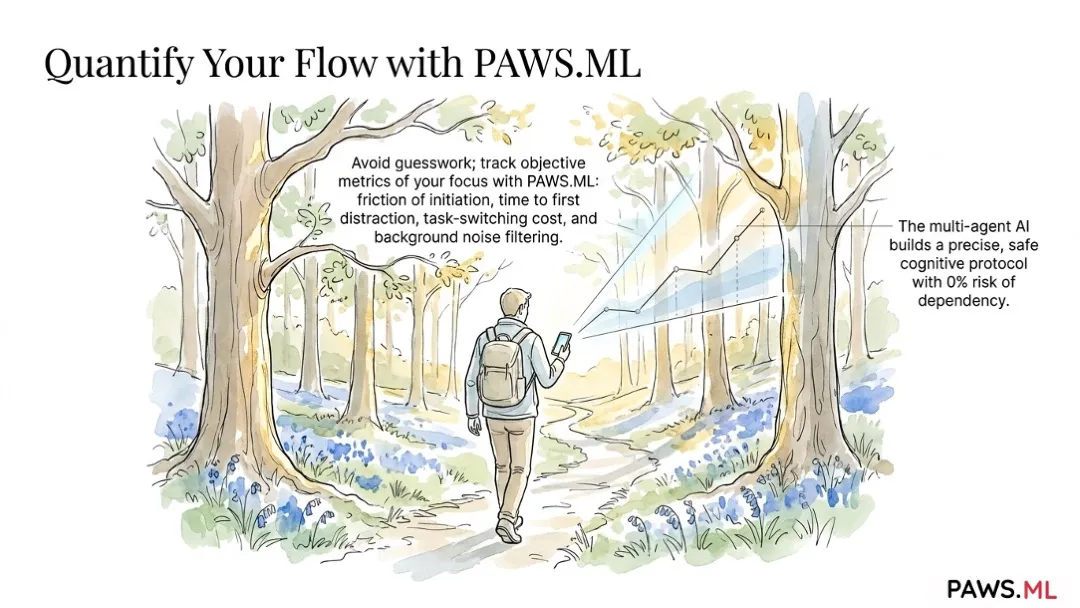
1.5 hours after taking the supplement, evaluate your condition not by your emotions, but by changes in your behaviour. In neuropsychology, there are 4 distinct metrics of focus. Quantify them:
-
Activation Friction: How difficult was it for you to take the first step?
- Before: Stared at the monitor for 40 minutes feeling pained by the need to start.
- After: Thought about the task, opened the file, and started typing without internal resistance.
-
Time-to-Distraction:
- Before: Checked WhatsApp or went to put the kettle on every 4 minutes.
- After: The phone has been lying face down for 45 minutes, and you have no desire to check it. You are in a state of “flow”.
-
Task-Switching Cost: What happens when you are interrupted (a colleague comes over, an urgent email arrives)?
- Before: After answering your colleague, you wander round the office for 15 minutes trying to remember where you left off.
- After: You answer the question and 10 seconds later resume typing from the exact same word. Your working memory retains the context.
-
Sensory Gating:
- Before: Any background noise distracted you; your brain couldn’t filter it out.
- After: You are working calmly in a noisy open-plan office; your brain automatically “muffles” unnecessary sounds (your prefrontal cortex is functioning as an excellent filter again).
The Verdict for Your Brain
Keep this “biohacker’s diary” for a few days. Record your metrics on days with L-Tyrosine and on days without it.
What conclusion will you draw? L-Tyrosine won’t write code for you, it won’t invent a brilliant business plan, and it won’t turn you into a tireless robot.
Its true, scientifically proven superpower lies elsewhere: it gives you back control over your own brain during moments of exhaustion.
When stress, deadlines, or recovery from addictions deplete your reserves of dopamine and noradrenaline, L-Tyrosine acts as a safety net. It removes paralysing apathy, lowers the “task-switching cost”, and allows you to simply sit down and do what needs to be done.
It isn’t a placebo, and it isn’t magic. It is simply pure, pragmatic biochemistry that, when used correctly, works for your success.
Ready to take control of your recovery process? Our AI assistant on the homepage at paws.ml will help you safely track your symptoms of Post-acute withdrawal syndrome (PAWS), select the right supplements, and avoid dangerous interactions.