The “Wooden Body” Phenomenon: Why You Feel Locked in a Muscle Straightjacket (And How to Fix It)
If you are perfectly healthy, imagine waking up one day and realizing your body has forgotten how to be soft. You try to stretch, but you feel like you are walking like a wooden plank. You try to take a deep breath, but it feels like you are locked in a straightjacket of muscle. Sounds like a bizarre sci-fi movie, right?
But if you are navigating chronic stress, CPTSD, or Post-Acute Withdrawal Syndrome (PAWS), you know exactly what we are talking about. For you, this isn’t a movie. It’s just Tuesday.
People all over the internet are desperately typing things like “constant whole body muscle tension cannot relax” into Google at 3 AM. They visit massage therapists, try yoga, and take hot baths, only to realize that their base state is always tense.
If you feel like your body is put together wrong every day, take a deep breath (if your chest allows it). You are not going crazy. You are experiencing a highly documented neurological phenomenon known as Body Armoring.
Let’s look at how this “sympathetic armor” shows up in real life. See how many of these bizarre sensations you can check off your list.
The Anatomy of the Invisible Armor
When your nervous system is glitching, it doesn’t just make you feel anxious; it physically changes how you carry yourself. Here is how people in recovery communities describe this exhausting reality:
1. The “Shoulder Earrings” (Neck & Traps)
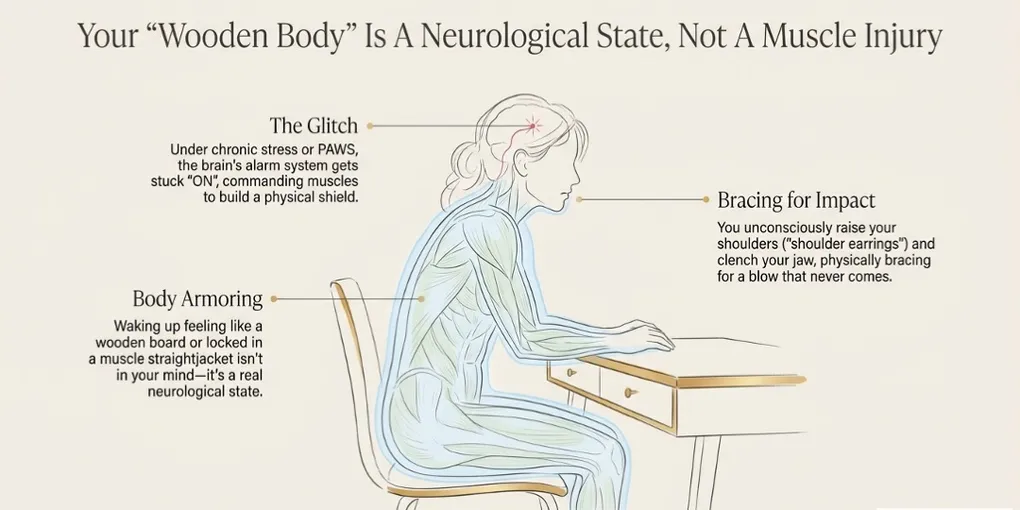
Have you ever caught yourself typing at your desk and realized your shoulders are touching your ears? People constantly search for “why do my shoulders always feel raised”, and the answer is simple: your body is unconsciously guarding your neck. It feels like someone placed a concrete block on your traps. Your shoulders are a hotspot for tension, and no matter how many times you tell them to drop, they just creep right back up.
2. The “Lead Legs” (Lower Body Heaviness)
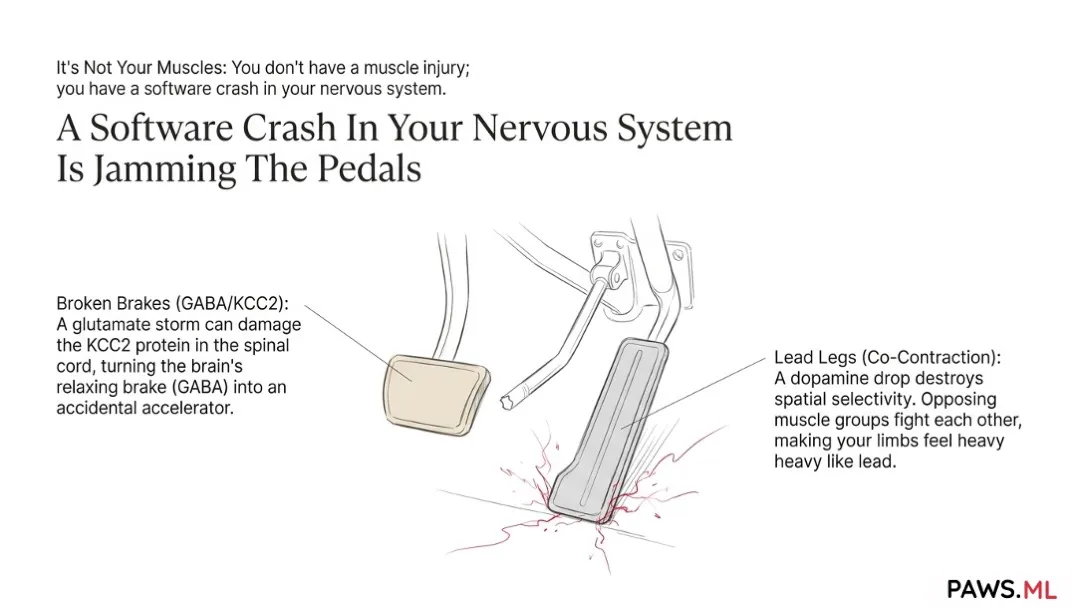
Walking shouldn’t feel like an Olympic sport. Yet, many people google “legs feel heavy like lead anxiety” because every step requires massive effort. You experience a swinish heaviness in your limbs, as if you are dragging invisible weights. It’s not muscle fatigue from a workout; it’s a neurological heaviness that makes your legs feel like lead.
3. The Micro-Tensions (The Sneaky Clenches)
Body armoring doesn’t just affect the big muscles; it hijacks the tiny ones, too. You might notice:
- Awake bruxism: You catch yourself jaw clenching so hard during the day that you feel like these cheeks could crack a walnut.
- The Tongue Press: You are pressing your tongue against the roof of your mouth really hard without realizing it.
- The Fist Balling: You find marks from your nails in the palms of your hands because your hands are constantly balling into fists.
- The Pelvic Lock: There is a direct “jaw and pelvis clenching stress connection”. Many people don’t realize they are holding a deep pelvic floor spasm until they consciously try to unclench their perineum.
4. The 24/7 Boxer (The Overall Exhaustion)
Perhaps the most exhausting part of this phenomenon is the feeling that you are bracing for an impact that never comes. You walk around bracing yourself for a punch in the stomach. You feel like you are being physically attacked 24/7, even when you are just watching Netflix. You wake up in the morning feeling like you’ve spent 8 hours in the gym, simply because your muscles were fighting an invisible war all night. Some people even describe this extreme rigidity as feeling like the first stage of rigor mortis, where the muscles feel like bone rather than tissue.
Why Is This Happening? (Spoiler: It’s Not Your Muscles)
If you are frantically searching “how to stop body armoring anxiety”, the first thing you need to understand is this: You do not have a muscle problem. You have a software glitch.
When you step away from substances (like alcohol, sleeping pills, or antidepressants) or endure prolonged trauma, your brain’s alarm system gets stuck in the “ON” position. Your brain genuinely believes you are in mortal danger. So, what does it do? It sends a continuous electrical signal to your spinal cord, commanding your muscles to build a physical shield.
Your muscles are just following orders. They are locked in a state of constant contraction because your nervous system is screaming at them to protect you.
But here is the good news: because this is a neurological issue, it can be systematically decoded and fixed. The “wooden body” is just a symptom. To actually melt the armor, we have to look under the hood and see exactly which neuro-systems are misfiring.
What’s Broken Under the Hood? (The Neuroscience of the Armor)
If you’ve tried aggressive deep-tissue massages, hot yoga, or stretching, you probably noticed something frustrating: it doesn’t work. In fact, stretching often makes the stiffness worse.
Why? Because you are trying to fix a hardware problem, but your body is suffering from a software crash.
When you are in PAWS or chronic stress, the delicate chemical balance in your brain and spinal cord is thrown into chaos. The symptom is always the same—you feel like a wooden board—but the cause could be one of several completely different neurological glitches.
Here are the four main systems that might be misfiring in your body right now:
1. The Flipped Brake Pedal (GABA/Glutamate Imbalance & KCC2)
Normally, your brain has a gas pedal (Glutamate) and a brake pedal (GABA). When you want to relax, your brain releases GABA.
But during withdrawal, your brain is flooded with a Glutamate Storm. This toxic storm damages a tiny, crucial protein in your spinal cord called KCC2.
When KCC2 breaks, something terrifying happens: the wiring gets flipped. Your brain presses the GABA “brake pedal” to relax your muscles, but because the wires are crossed, it acts like a gas pedal. Your muscles receive a massive jolt of electricity and lock up. This is why you can’t “just relax”—your body’s relaxation chemical is accidentally causing spasms.
2. Driving with the Parking Brake On (Dopamine & The Basal Ganglia)
Dopamine isn’t just about feeling happy; it is the chemical that makes human movement smooth and fluid. It tells your brain how to isolate muscles (e.g., contracting your bicep while relaxing your tricep).
When dopamine levels crash, your brain loses this “spatial specificity.” It forgets how to move one muscle at a time. Instead, it activates opposing muscles simultaneously. Your flexors and extensors fight each other, locking your joints in a vice. This is called co-contraction, and it’s the exact reason your legs feel like lead and your movements feel like a rusty robot.
3. The Faulty Car Alarm (Sympathetic Overdrive & The Gamma Loop)
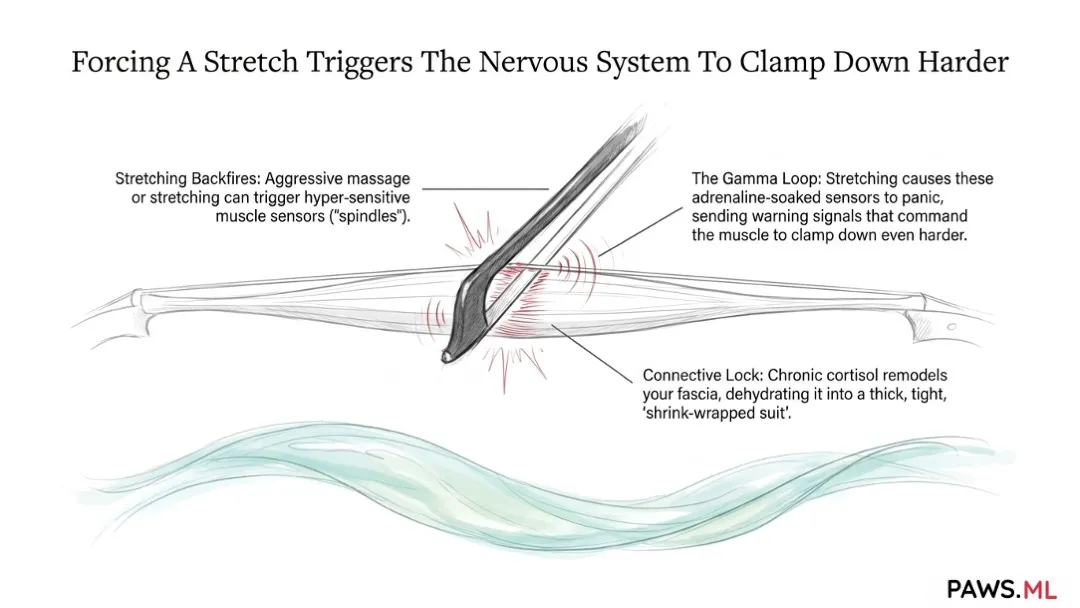
Your muscles have tiny sensors inside them called “spindles.” When you are in a state of chronic “fight-or-flight,” your brain pumps adrenaline directly into these spindles.
This makes the sensors hyper-sensitive. Even when you are sitting still, they send a false alarm to your spinal cord, screaming: “The muscle is tearing! Brace for impact!” Your spinal cord instantly locks the muscle to protect it.
This is the Gamma Loop. And this is why stretching makes you feel worse: when you stretch, you trigger that hyper-sensitive alarm, and the muscle fights back by clamping down even harder.
4. The Shrink-Wrapped Suit (Fascial Remodeling)
If you feel like your skin and tendons are two sizes too small, you aren’t imagining it. Chronic stress floods your body with cortisol. High cortisol literally changes the cellular structure of your fascia (the connective tissue wrapping your muscles). It transforms normal cells into myofibroblasts—cells that contract on their own. Your fascia dehydrates, thickens, and turns into a rigid, shrink-wrapped suit.
Why Guessing is a Dangerous Game (And How AI Can Help)
Let’s look at the facts. You feel stiff, heavy, and locked up. But as you can see, the root cause could be a Glutamate storm, a Dopamine crash, a broken Gamma Loop, or Cortisol-soaked fascia.
This is why trying to fix PAWS on your own is like playing Russian roulette.
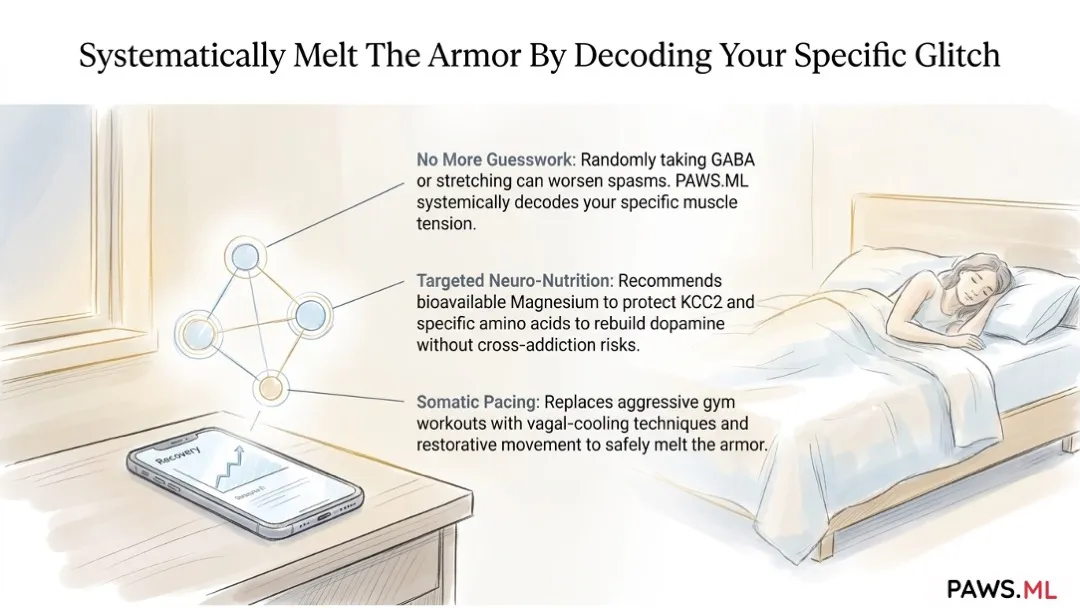
- If you take a supplement to boost GABA, but your KCC2 protein is broken, you will actually make your muscle spasms worse.
- If you try to stretch a Gamma Loop issue, you will trigger more pain.
- If you take random vitamins without understanding your specific neuro-deficit, you are just throwing darts in the dark.
You don’t need to guess. You need a translator.
This is exactly why we built PAWS ML. PAWS ML is a personal AI assistant designed specifically to decode the bizarre, terrifying signals your body is sending during neuro-recovery.
How it breaks the cycle of the “Wooden Body”:
- It Decodes Your Symptoms: You tell the AI about your “lead legs,” your “shoulder earrings,” or your jaw clenching. The AI analyzes these specific patterns to identify exactly which system (Dopamine, GABA, or Sympathetic) is currently misfiring.
- Targeted Neuro-Nutrition (Zero Pharma): Once the AI knows what is broken, it doesn’t recommend heavy psychiatric drugs. Instead, it selects precise, safe, and legal neuro-nutrition (specific amino acids, vitamins, and adaptogens) designed to repair that exact pathway. Need to calm a Glutamate storm? Need to restore KCC2? The AI knows exactly what your brain needs to rebuild itself.
- 24/7 Safety Screening: The AI constantly tracks your “waves” of symptoms, adjusts your protocol, and screens for any supplement interactions, ensuring your recovery is 100% safe.
You are not permanently broken, and you don’t have to live in a suit of armor. Your body is just waiting for the right instructions to heal.
Stop fighting your muscles. Let PAWS ML translate the signals, balance your brain chemistry, and help you finally feel soft, fluid, and human again.
FAQ
Why do my shoulders always feel raised when I am stressed?
Your shoulders feel raised because your brain is trapped in a “fight-or-flight” state, constantly activating the Gamma Loop. This neurological reflex forces your trapezius muscles to contract and build a protective armor around your neck, making it physically impossible to just drop them.
Why do my legs feel heavy like lead during anxiety or PAWS?
Your legs feel heavy like lead due to a drop in dopamine and a GABA receptor imbalance. This causes “co-contraction,” where opposing leg muscles fight against each other simultaneously. You are essentially walking with your body’s parking brake on, requiring massive effort.
What causes constant whole body muscle tension when I cannot relax?
Constant whole-body tension is caused by a “Glutamate storm” that damages the KCC2 protein in your spinal cord. When this happens, your brain’s relaxation signals (GABA) accidentally act as excitants. Your nervous system literally misfires, turning relaxation commands into muscle spasms.
Is there a jaw and pelvis clenching stress connection?
Yes, there is a direct neurological connection between your jaw and pelvic floor. Both areas are highly reactive to sympathetic nervous system overdrive. When chronic stress triggers awake bruxism (jaw clenching), the pelvic muscles reflexively lock up as part of a full-body defensive armor.
How to stop body armoring anxiety safely without heavy medication?
To stop body armoring, you must repair your brain chemistry rather than just stretching muscles. The PAWS ML AI assistant analyzes your specific symptoms to identify the exact neurological glitch. It then recommends targeted, safe neuro-nutrition to calm the nervous system and dissolve the armor naturally.
If you are currently experiencing the symptoms of Protracted Withdrawal Syndrome, return to our main page to explore how our AI recovery assistant can help stabilize your neurochemistry.