Internal tremors after quitting benzos: Causes & safe relief
Internal shaking months after quitting benzos: You are not developing parkinson’s
Disclaimer: The information in this article is for educational purposes only and does not substitute for professional medical advice. If you are experiencing visible, uncontrollable full-body convulsions or suspect a seizure, seek emergency medical care immediately.
You took the brave step to stop taking your medication. Whether you tapered slowly or quit abruptly, it has now been one or two months since your last dose of Xanax, Valium, Klonopin, or Ativan. The acute physical detox is behind you, and you thought the worst was over.
But now, a terrifying new symptom has emerged. You can’t sleep because your body feels like it is vibrating from the inside out. It feels like there is a cell phone buzzing on silent mode inside your chest, spine, or legs. When you look at your hands, they aren’t visibly shaking, so when you explain this to your doctor or your family, they dismiss it: “It’s just your anxiety coming back. Just relax.”
You start Googling your symptoms in a panic. You wonder, “Am I developing Parkinson’s disease? Is this Multiple Sclerosis? Is my nervous system permanently damaged?”
Please, take a deep, slow breath. You do not have Parkinson’s, and you are not going crazy. What you are experiencing is a very real, physical symptom of healing known as internal tremors, which is a hallmark of BIND (Benzodiazepine-Induced Neurological Dysfunction), previously referred to as Benzo PAWS.
Let’s dive into the neuroscience of why xanax withdrawal internal shaking happens, how long it lasts, and how to safely calm your nervous system without setting your recovery back.
What are internal tremors? (The “buzzing” sensation explained)
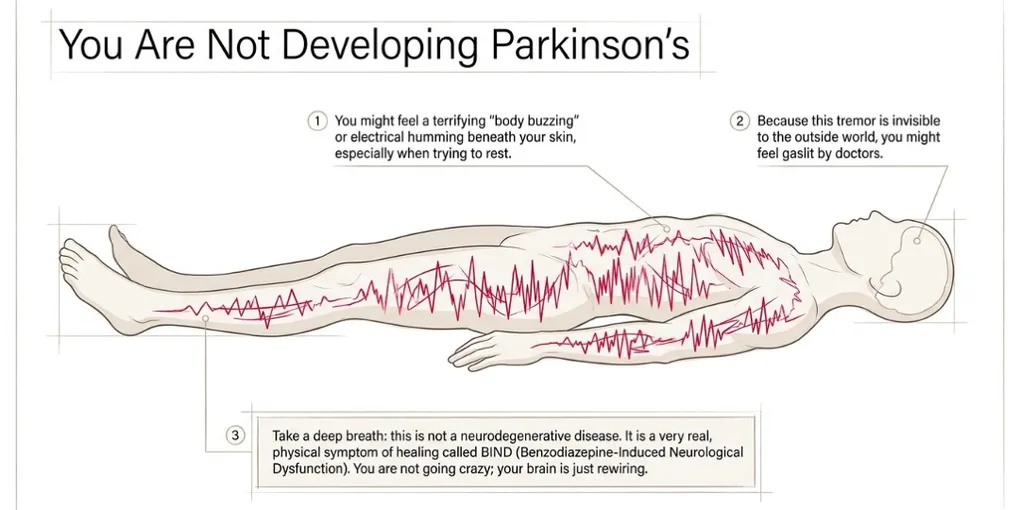
Internal tremors are often described by patients as a “body buzzing,” “internal shivering,” or a feeling of electricity humming beneath the skin.
Unlike a classic tremor (where your hands or limbs visibly shake), an internal tremor is usually invisible to the outside world. It is a sensory disruption. Body buzzing from benzos is typically most noticeable when you are trying to rest, lie down, or sleep. It can fluctuate in intensity, sometimes localized to your chest or legs, and other times vibrating through your entire body.
Because it is invisible, it is highly distressing. But understanding why it happens is the first step to taking your power back.
The neuroscience: Why does benzo withdrawal cause internal vibrations?
Benzodiazepines are powerful central nervous system (CNS) depressants. They do not just calm you down; they physically alter the architecture of your brain. Here is why your body is vibrating:
1. The gaba/glutamate war
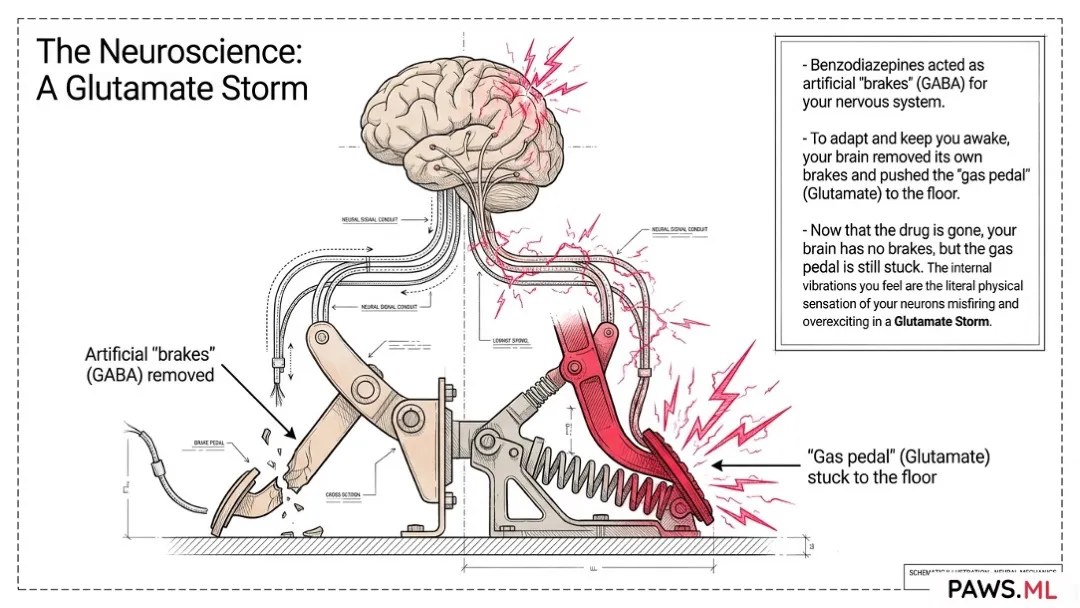
Benzodiazepines artificially enhance GABA, the brain’s primary “brakes” (the calming neurotransmitter). To survive this constant sedation, your brain adapted by downregulating (removing) its own GABA receptors and pumping out massive amounts of Glutamate (the “gas pedal” or stress neurotransmitter) to keep you awake.
Now that the benzos are out of your system, your brain has no brakes, and the gas pedal is stuck to the floor. You are in the middle of a Glutamate Storm. The internal vibrations you feel are the literal physical sensation of your neurons misfiring and firing too rapidly due to neurochemical overexcitement.
2. Central nervous system (CNS) hypersensitivity
Because your GABA receptors are depleted, your nervous system is completely bare and exposed. This is known as CNS hypersensitivity. It is why a normal stimulus—like a loud noise, a stressful email, or a single cup of coffee—can cause your internal vibrations to skyrocket. Your nerves are reacting to everyday life as if it were a life-or-death threat.
The danger of treating benzo PAWS with “internet supplements”
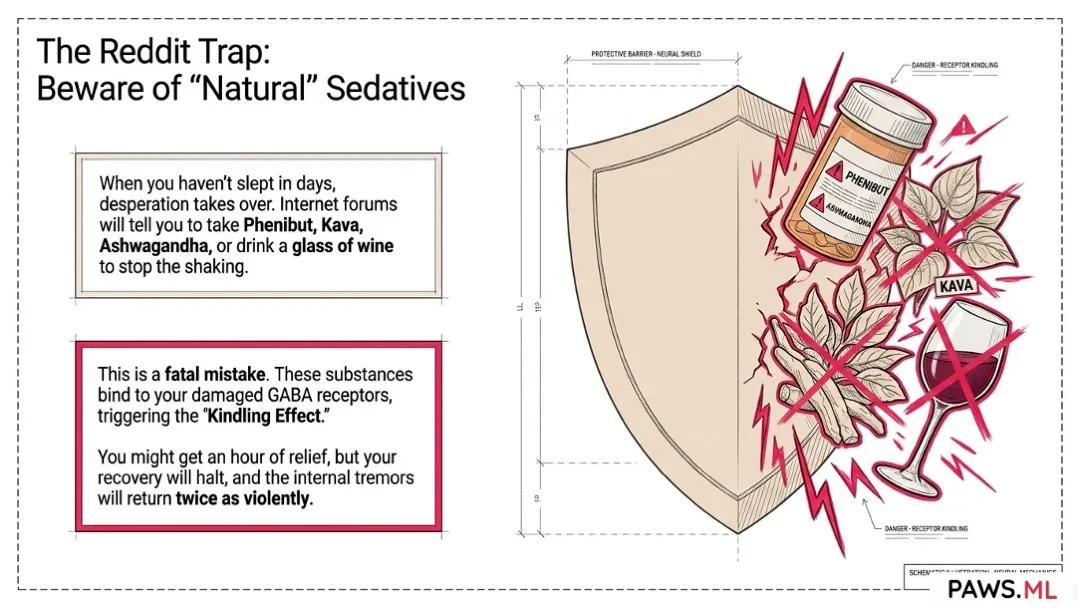
When your body is vibrating 24/7 and you haven’t slept in days, desperation takes over. You might turn to Reddit or Facebook groups searching for relief. There, well-meaning people often recommend supplements like Phenibut, Kava-Kava, Ashwagandha, or mega-doses of herbal sedatives.
For a brain recovering from benzodiazepines, taking these can be a fatal mistake.
Many of these “natural” supplements are highly GABAergic—meaning they bind to the exact same damaged receptors that the benzos did. If you take them, you might temporarily stop the shaking, but you will trigger the Kindling Effect. This means you will instantly halt your brain’s healing process, and when the supplement wears off, your internal tremors will come back twice as violently. You also risk severe drug interactions if you are taking beta-blockers or blood pressure medications.
Your fragile nervous system requires surgical precision, not blind internet experiments. That is why we built PAWS.ML — your personal, AI-driven neuro-recovery navigator:
- 📉 “Waves and Windows” Tracker: Internal tremors fluctuate wildly. Our AI tracks your symptoms, proving to you with objective data that the vibrations are becoming less intense month over month, even on bad days.
- 🛡️ Pharmacology Safety Agent: Before you try any supplement, our AI rigorously cross-checks it. For benzo recovery, our absolute golden rule is 0% GABAergic cross-addiction risk. We block the dangerous “internet remedies” that could cause kindling.
- 💊 Safe Neuro-Nutrition: The AI recommends safe cofactors (like specific forms of magnesium) that help block the glutamate storm without touching your healing GABA receptors.
- 💬 AI Coordinator: An empathetic digital companion that understands the unique terror of BIND symptoms, calming you down during a severe “Wave” of tremors.
Don’t play Russian roulette with your GABA receptors. Let an intelligent, medically secure AI agent guide your healing.
👉 Track your healing and get a safe BIND recovery plan with PAWS.ML)
How long do internal tremors last after benzos? (The BIND timeline)
When looking for the GABA receptors healing time, it is crucial to manage your expectations. Because receptors are made of proteins, your brain has to physically grow them back from scratch (a process called upregulation). This takes time.
So, how long do internal tremors last? Unlike acute detox symptoms, BIND symptoms do not vanish in 14 days. Internal tremors typically occur in “Waves and Windows” (sudden flare-ups and periods of relief) that can last anywhere from 2 to 12 months post-taper.
However, they will not be at maximum intensity this entire time. Month 1 and 2 are usually the peak of the internal buzzing. By Month 4 or 6, the vibrations will likely only return during moments of intense stress, poor sleep, or illness. Eventually, as neuroplasticity completes its job, they will fade away completely.
4 safe, non-addictive ways to calm the vibrations
While you give your brain the months it needs to rebuild, you can use these safe, non-GABAergic strategies to calm the glutamate storm:
1. The alcohol trap (avoid cross-addiction)
Do not drink alcohol. Alcohol and benzodiazepines are chemical cousins; they act on the exact same GABA receptors. Drinking a glass of wine might stop the internal shaking for an hour, but the next morning, you will experience a horrific rebound effect. Drinking alcohol during benzo PAWS is like pouring gasoline on a fire. (For more strategies on avoiding cross addiction alcohol benzos, see our comprehensive coping guide).
2. Magnesium glycinate (the glutamate blocker)
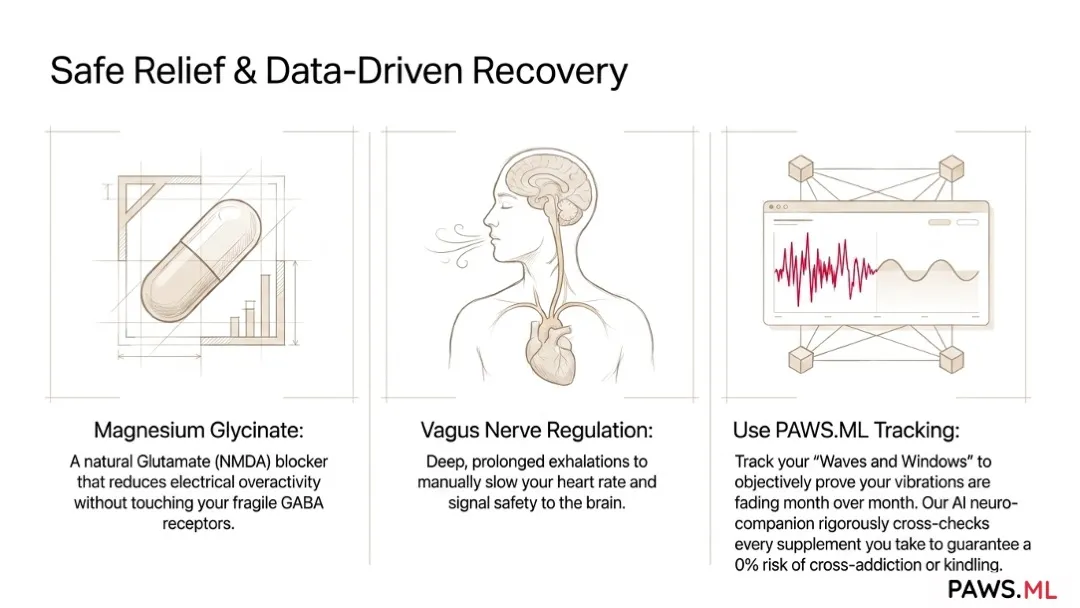
Unlike herbal sedatives that mess with GABA, Magnesium acts as a natural blocker for NMDA (glutamate) receptors. Specifically, Magnesium Glycinate can physically reduce the electrical overactivity in your muscles and nervous system, helping to ease the internal buzzing and promote sleep, without causing dependency.
3. Somatic tracking & vagus nerve regulation
When you feel the buzzing, your instinct is to panic and fight it. Fighting it releases adrenaline, making the tremors worse. Practice somatic tracking: lie down, breathe slowly (inhale for 4 seconds, exhale for 6), and simply observe the buzzing without judgment. Stimulating the Vagus nerve through deep exhalations forces your heart rate down and signals to your brain that you are safe.
4. Beta-blockers (the medical route)
If the internal tremors are accompanied by a dangerously high heart rate and severe physical panic, some doctors prescribe a beta-blocker like Propranolol. Beta-blockers stop adrenaline from binding to receptors in your heart and muscles. They do not fix the brain, but they can stop the physical shaking. (Always have your doctor or the PAWS.ML safety agent check for interactions before starting new medications).
Conclusion & when to seek emergency help
Internal tremors are horrifying, exhausting, and incredibly frustrating to explain to people who have never felt them. But remember this: benzo PAWS vibrations are the physical sensation of your brain healing. You are not permanently damaged. Every time you survive a wave of buzzing without taking a pill or a drink, your brain has grown a microscopic fraction of a new receptor.
⚠️ Medical Red Flags: While internal tremors are a normal part of prolonged withdrawal, BIND can sometimes present acute dangers if you quit your medication “cold turkey” (abruptly). Seek immediate emergency medical care (Call 911) if your internal tremors escalate to:
- Visible, uncontrollable full-body convulsions;
- A loss of consciousness;
- An inability to swallow or breathe.
For the invisible, buzzing anxiety of standard PAWS, patience, safe nutrition, and objective tracking are your keys to total freedom.
If you are currently experiencing the challenges of Post-withdrawal syndrome, return to our main page to explore how our AI recovery assistant can help stabilize your neurochemistry.