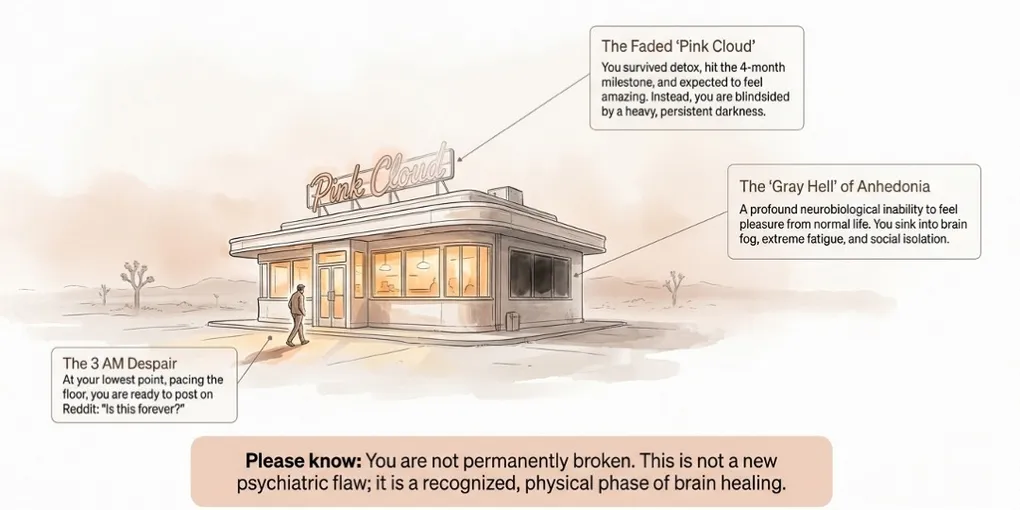
The PAWS timeline & the "gray hell" of sobriety: When does it end?
4 months sober and miserable? The 3 AM reddit post
You are probably ready to write that desperate post on Reddit: “I haven’t used in 4 months, my life is a living hell. Tell me honestly, is this forever?”
Completing acute detox marks a massive milestone in recovery, and many expect the hardest part to be over once the substance leaves the body. However, instead of feeling liberated, you might feel completely blindsided by a new, lingering darkness. You are experiencing the harsh “rollercoaster” of early sobriety. While the acute physical symptoms may have faded, the psychological agony is taking center stage as your brain attempts to adjust to abstinence.
Early sobriety anhedonia & brain fog: The isolation of pain
The condition you are experiencing goes far beyond a simple bad mood. It is characterized by a complete depletion of willpower, profound emotional dysregulation, and severe cognitive impairments, often referred to as “brain fog”. You might be suffering from anhedonia—a neurobiological inability to derive pleasure from naturally rewarding activities—which leaves you feeling empty, unmotivated, and numb.
In this “gray hell,” suicidal thoughts often emerge, driven by an overwhelming sense of hopelessness and mental defeat. Patients frequently report a sense of total social isolation and self-perceived burden, feeling entirely disconnected from their loved ones while drowning in their own invisible pain. This psychological distress is often accompanied by intense anxiety, panic episodes, severe insomnia, and unpredictable mood swings that make daily functioning feel impossible.
The post-acute withdrawal syndrome timeline: “Windows and waves”
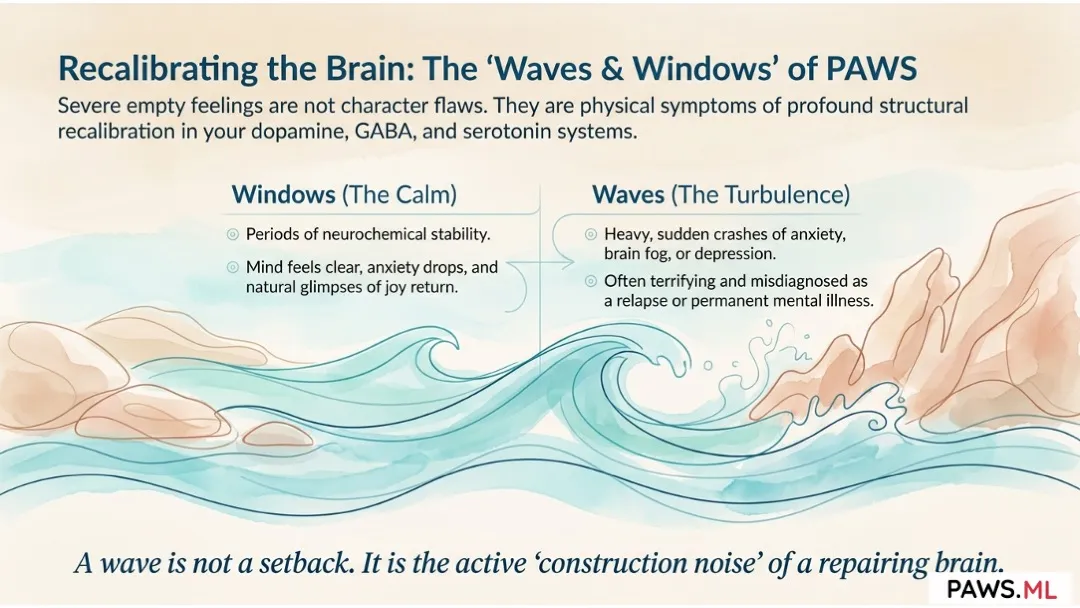
Here is the most crucial therapeutic insight you need right now: you have not lost your mind, you are not permanently broken, and this condition has a name. It is called Post-Acute Withdrawal Syndrome (PAWS)—also known as protracted withdrawal.
What you are feeling is a direct result of profound molecular, cellular, and neurocircuitry changes in your central nervous system caused by chronic substance exposure. Your brain’s reward and inhibition pathways—particularly the dopamine, GABA, and serotonin systems—were hijacked and are now undergoing a massive, painful recalibration to restore their natural chemical balance.
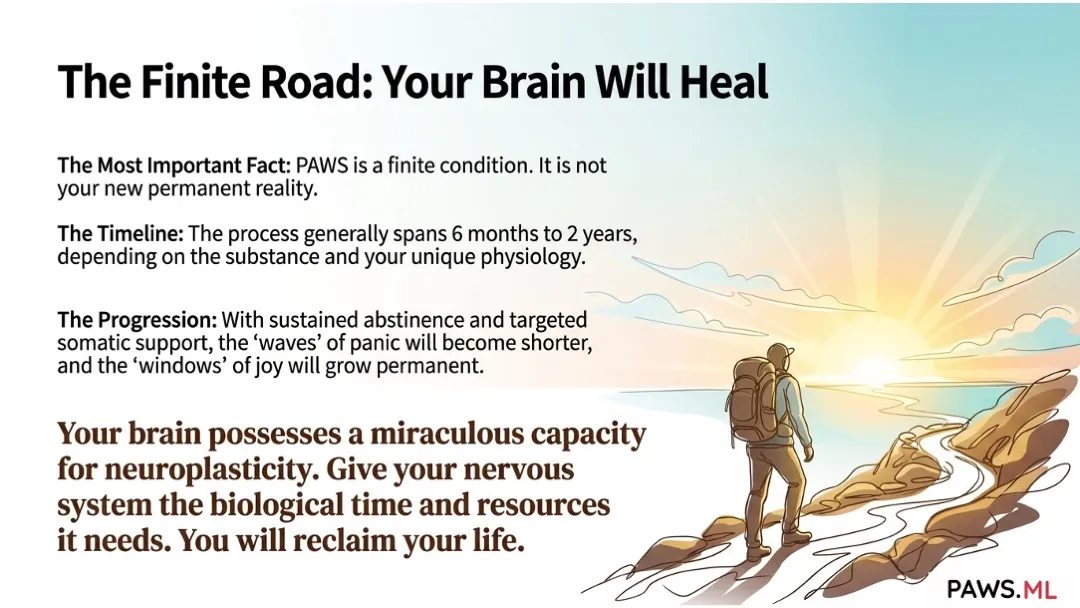
The most important fact about PAWS is that it is a finite condition. The timeline for PAWS generally spans from 6 months to 2 years, depending on the substance, the duration of use, and individual physiology. However, healing is rarely linear. PAWS operates in unpredictable “waves” or “windows and waves”. You might feel fine for weeks, only to be hit by a sudden, intense wave of anxiety or depression out of nowhere. These flare-ups are not a sign of treatment failure; they are simply evidence that your brain is actively repairing its neural pathways.
AI support for addiction recovery: A companion for the darkest hours
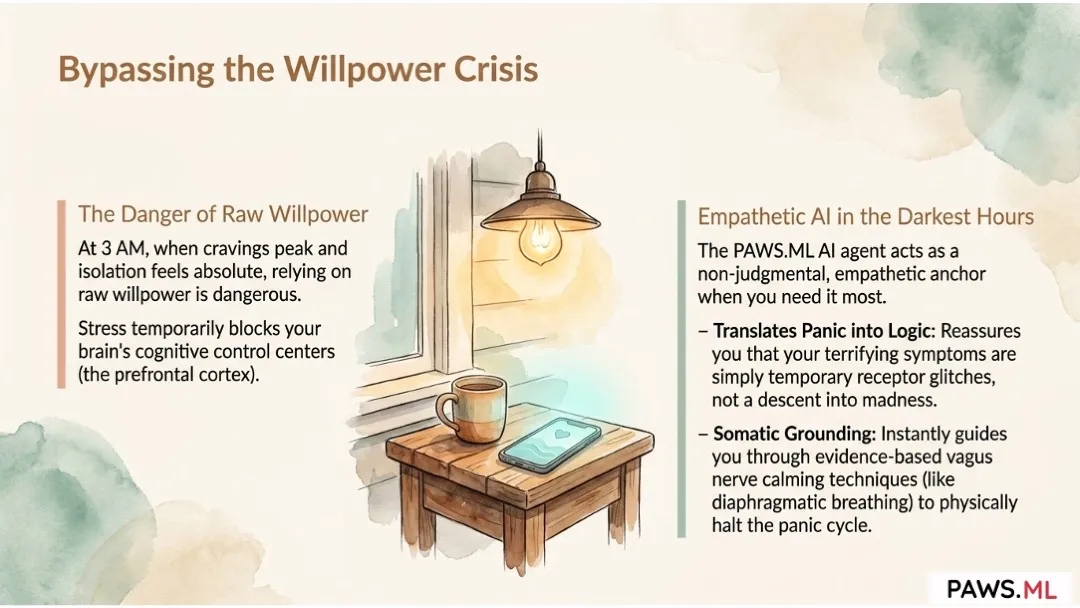
In moments of profound despair, willpower alone is not enough. You need someone by your side. This is where the PAWS ML AI agent steps in.
PAWS ML is not just a software program; it is an empathetic companion built upon the lived experiences of thousands of individuals in recovery and the latest advancements in addiction neuroscience. Research shows that neuroscience-informed psychoeducation significantly reduces self-stigma, increases psychological resilience, and helps individuals understand that their cognitive “glitches” are temporary receptor dysfunctions, not irreversible character flaws.
At 3 AM, when cravings peak and isolation feels absolute, PAWS ML provides immediate, non-judgmental psychological support. It steps in to remind you that the crushing anxiety is just a temporary PAWS “wave” passing through your nervous system. By delivering on-demand, evidence-based coping strategies and grounding techniques, PAWS ML guides you safely out of the crisis, preventing catastrophic relapse scenarios and ensuring you never have to face the gray hell of sobriety alone.
FAQ: Understanding PAWS timelines and early sobriety symptoms
How long does Post-Acute Withdrawal Syndrome (PAWS) last? The timeline for Post-Acute Withdrawal Syndrome (PAWS) generally lasts anywhere from 6 months to 2 years after you stop using a substance. The exact duration depends on the specific substance used, how long you used it, and your unique physiology. It is important to remember that PAWS is a finite condition—your brain is actively repairing its dopamine and GABA receptors, and these symptoms will eventually end.
What are the “windows and waves” in the PAWS timeline? Healing from addiction is not a linear process. In PAWS recovery, a “window” is a period where you feel normal, clear-headed, and symptom-free. A “wave” is a sudden, unpredictable flare-up of intense anxiety, depression, or cravings. These waves often make people feel like they are relapsing or permanently broken, but they are actually a biological sign that your central nervous system is recalibrating and healing.
Why do I have severe anhedonia and brain fog months after quitting? Experiencing anhedonia (the inability to feel pleasure) and “brain fog” months into early sobriety is a hallmark symptom of PAWS. This happens because chronic substance use hijacks and depletes your brain’s reward pathways. Your nervous system is currently suffering from a temporary dopamine and serotonin deficit. Tools like the PAWS ML AI agent can help you manage these symptoms through neuroscience-informed coping strategies while your brain naturally restores its chemical balance.
If you are currently experiencing the challenges of Persistent post-use symptoms, return to our main page to explore how our AI recovery assistant can help stabilize your neurochemistry.