Why you might feel 'normal' while drinking—until the moment you try to stop
Let’s get one thing straight right out of the gate: you don’t need to slap a label on yourself, hit “rock bottom,” or accept a scary diagnosis to admit that something feels off. You are not broken, and you are not a lost cause. Let’s take the guilt and the emotional baggage out of the equation and just look at the mechanics of what’s happening under the hood.
Chances are, that low-grade morning dread, the constant brain fog, the fragmented sleep, and the bone-deep fatigue aren’t just early aging. It’s not just the daily grind, burnout, or the stress of modern life.
It’s your brain running on fumes.
Here is what alcohol is actually doing to your biological “operating system,” and why taking a step back from your usual evening glass might be the biggest breakthrough of your life.
The “new normal” trap: How we forget who we used to be
The most dangerous thing about a gradual decline is our phenomenal ability to adapt to it. Nobody wakes up on a random Tuesday and thinks, “Wow, my life just got 30% duller, and I feel significantly slower today.”
The changes happen in micro-doses. So slowly, in fact, that a slightly more exhausted, irritable, and anxious version of you simply becomes your “baseline.” Anxiety turns into background noise. Sleep becomes just a period of unconsciousness that leaves you unrefreshed. Your brain gets used to running at 70% capacity.
We shrug it off: “Well, I’m getting older. Work is crazy right now. Everyone feels like this, right?”
The mistake is that we forget to compare ourselves to the person we were before alcohol became a regular sponsor of our evenings.
It’s not just your liver. It’s your gas and brake pedals
We’ve been conditioned to think that alcohol primarily targets the liver. But the real drama is unfolding a few floors up—in your brain. Regular drinking doesn’t just “take the edge off.” It rewires your sleep architecture, hikes up your baseline stress levels, and hacks your motivation and reward pathways.
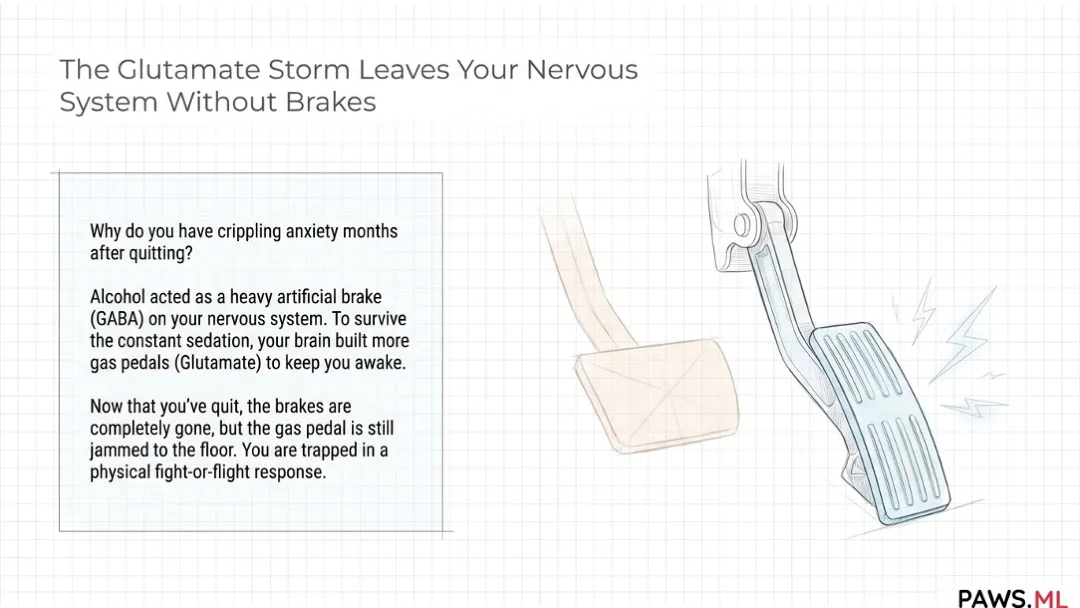
Imagine you’re driving a car. Alcohol is a powerful central nervous system depressant: it artificially slams on your neurological “brakes” (by boosting the calming neurotransmitter GABA) and blocks the “gas pedal” (by suppressing the excitatory glutamate). You feel deeply relaxed.
But your brain is incredibly smart and wired for survival. To keep you from essentially going into a coma from all this chemical braking, it adapts: it floors its own internal gas pedal to keep the engine running, ramping up your neural excitability.
This is exactly why your problem isn’t just a morning hangover. It’s how your brain operates 24/7. When the alcohol wears off, the brakes are released, but the gas pedal is still pinned to the floor. Your nervous system is left in a state of wild hyper-arousal. That’s the true source of your inexplicable morning anxiety (hello, hangxiety), the shaky hands, the racing heart, and the inability to focus.
Nutritional bankruptcy: The syndrome of depleted reserves
Regular drinking works like a hidden mortgage on your health with an extortionate interest rate. It literally drains your reserves.
Alcohol flushes out critical building blocks: primarily thiamine (Vitamin B1), but also folate, magnesium, phosphorus, and potassium. Magnesium, for example, is the exact mineral your brain uses to buffer stress and drop you into deep, restorative REM sleep. No magnesium? No armor against stress.
Crucial caveat: This doesn’t mean you can just pop a handful of supplements, “biohack” the system, and keep drinking heavily without consequences. You can’t out-supplement a heavy drinking habit.
But when your body is chronically starved of its basic fuel, is it any wonder the system keeps crashing? Replenishing these deficits often brings on a “lightbulb” moment: you suddenly realize how much your body’s chemistry was dictating your mood.
The checkpoint: Taking inventory of your baseline
You don’t need to play doctor and diagnose yourself. Let’s just take a quick inventory. Pinpoint your baseline right now.
Rate how you’ve felt over the last 30 days on a scale of 1 to 10 (where 10 is absolutely optimal):
- Sleep Quality: 1–10
- Daytime Energy: 1–10
- Background Anxiety (where 10 is completely calm): 1–10
- Overall Mood: 1–10
- Focus and Mental Clarity: 1–10
- Drive and Motivation: 1–10
If these numbers don’t look great, don’t beat yourself up. Just start paying attention.
“Pre-hab”: Can you cushion the fall before you jump?
Most people wait for a massive crisis, a rock-bottom moment, or a breakdown before they try to change something. But you don’t have to wait until the engine blows out to change the oil.
You can start prepping your body ahead of time: try to regulate your sleep hygiene, add some daily movement, and restock those depleted nutrients.
A critical safety rule, though: No amount of green juice or vitamins makes heavy drinking safe. Furthermore, if you’ve been drinking heavily for a long time, quitting “cold turkey” overnight can be physically dangerous (risk of severe withdrawal or seizures). A body that has run on altered chemistry for years needs a safe, gradual reset—ideally under medical supervision.
The PAWS trap: Why people relapse when they’re doing “everything right”
A lot of people think: “Okay, I’ll stop drinking, and by next Monday I’ll wake up glowing like a superhero.” Instead, a week into it, they get hit with a ton of bricks: crippling lethargy, insomnia, random irritability, and a thick mental fog.
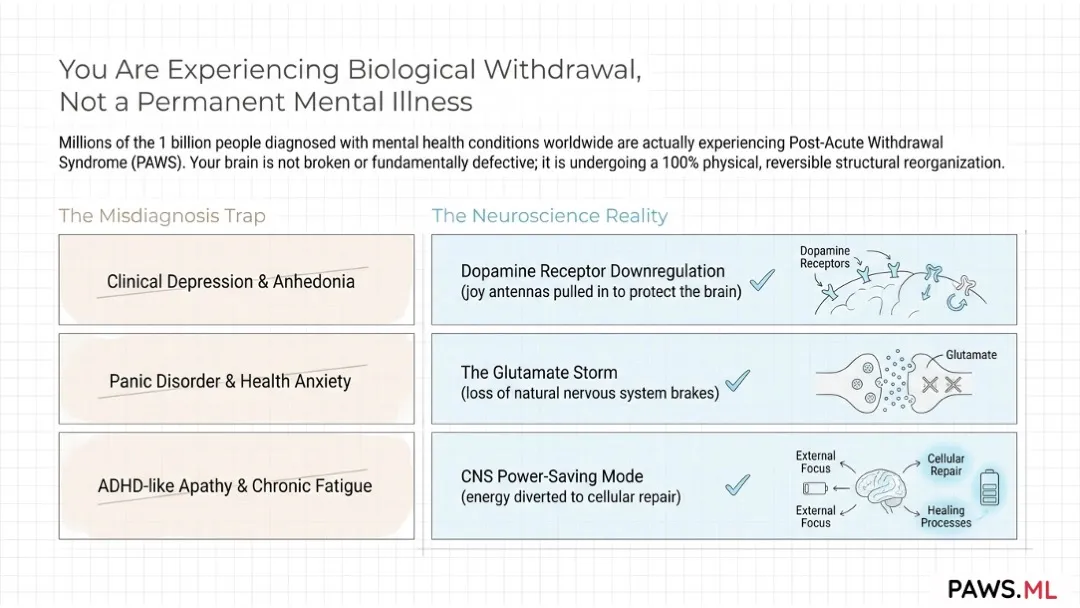
Meet PAWS (Post-Acute Withdrawal Syndrome). This is not a sign of your weakness.
Think of your brain as a house undergoing a massive gut renovation. It’s rewiring the electrical system, tearing down old drywall, and relearning how to produce its own “happy chemicals” without relying on a liquid loan. During construction, things get dusty, loud, and uncomfortable.
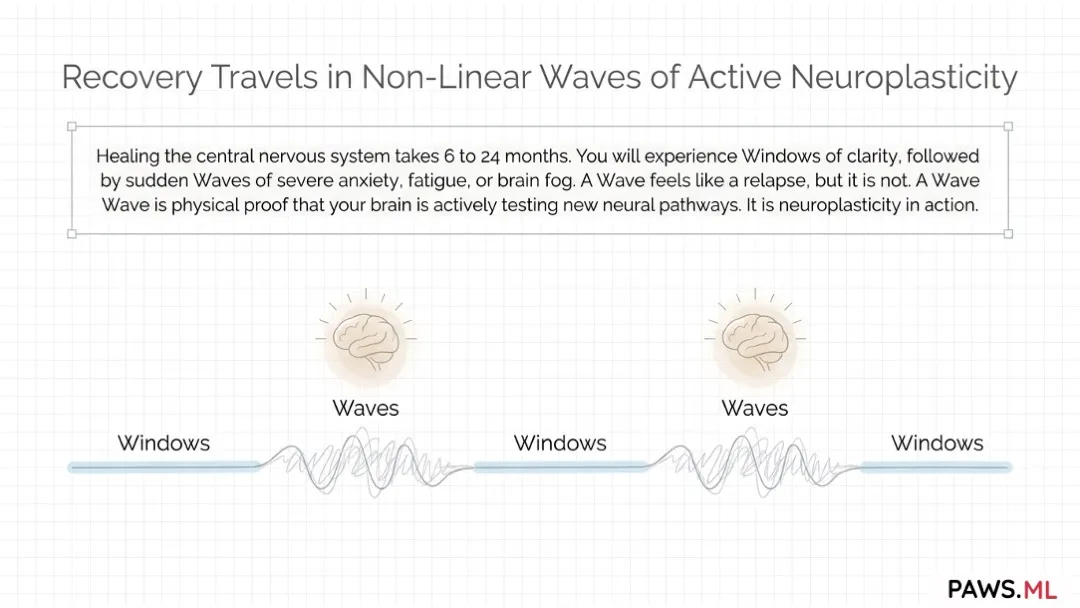
PAWS symptoms come in waves. They can crash over you out of nowhere, even months down the line. This is the exact moment people cave, making a fatal miscalculation: “I feel so much worse without alcohol. That must mean I need it to feel normal.”
But now you know the secret. You aren’t “getting worse.” You are under construction. If you know the renovation is temporary, you won’t abandon the house while it’s being built. Your brain is painstakingly rebuilding the architecture you chipped away at for years. Give it time.
What’s your next move?
The biggest catalyst for change isn’t white-knuckling it with sheer willpower. It’s genuine curiosity about yourself.
What would happen if you just started observing your body? You don’t need to swear a blood oath to sobriety right this second or burn your bridges. Start with an honest look at your metrics. Become a researcher of your own life.
Our AI-companion was built for exactly this. It helps you track your sleep, energy, mood, and cognitive function over time—anonymously, gently, and with zero judgment. You’ll get crystal-clear visual data showing exactly how your state shifts before, during, or after you decide to cut back.
Stop guessing how you feel. Let’s measure it—and get you back in control of your own baseline.
If you are currently experiencing the challenges of Post-withdrawal syndrome, return to our main page to explore how our AI recovery assistant can help stabilize your neurochemistry.