The wall of silence: why people pull away after quitting addictions (and how to help)
The wall of silence: why people pull away after quitting addictions (and how to help when words fail)
Disclaimer: The information in this article is for educational and informational purposes only and does not substitute for professional medical advice, clinical diagnosis, or treatment.
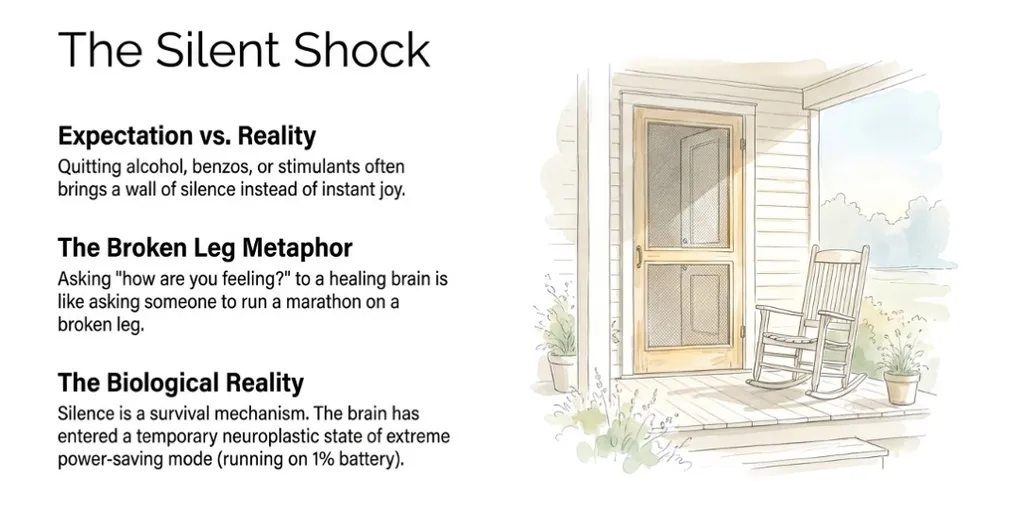
The hardest part, it seems, is finally behind you. Your partner, child, or close friend made a courageous decision to walk away from what was destroying them—whether that was alcohol, stimulants, benzos, or prescription sleep aids. You expect a bright new chapter to begin, filled with joy, relief, and renewed closeness. But instead, an unyielding wall of silence goes up.
Your loved one pulls away. They answer in one-word sentences, snap at gentle check-ins, avoid eye contact, and spend hours staring at a wall in their room. You feel hurt, anxious, and helpless. It feels as if they are rejecting you at the exact moment you want to offer support.
If you are reading this as a concerned partner or family member—please take a deep breath. They are not rejecting you. This is not stubbornness, resentment, or a passive-aggressive protest.
And if you are reading this from the other side—living through this heavy, silent period yourself—know this: there is nothing wrong with you. You are not broken. What you are feeling (or rather, what you cannot feel right now) has a clear biological explanation. You have every right to this quiet.
This state is called Post-Acute Withdrawal Syndrome (PAWS)—a protracted phase where acute detox is over, but the brain has entered a long, exhausting process of internal structural repair. And the primary temporary casualty of this neuroplastic healing is the ability to communicate.
The anatomy of silence: what is actually happening inside?
When a loved one asks, “What are you feeling right now? Talk to me,” they do so out of deep affection. But to a depleted brain, that question feels like being asked to sprint a marathon on a broken leg.
Here is why this formidable communication barrier forms:
1. Alexithymia: when emotions lose their names
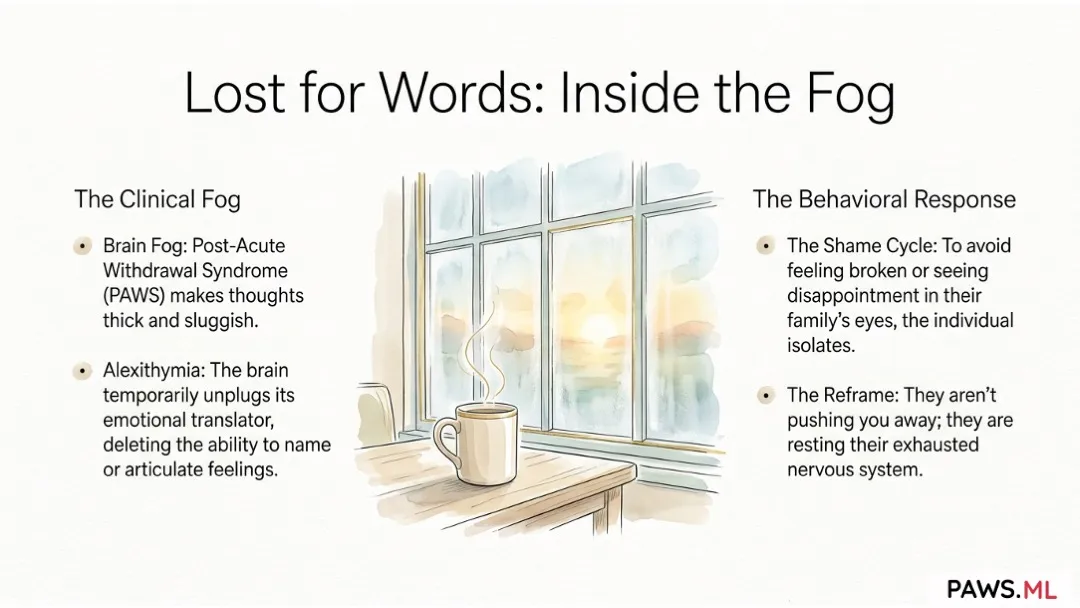
Alexithymia is a scientifically documented state where a person temporarily loses the capacity to identify, process, and describe their emotions. During PAWS, a heavy, unformed sensation of “feeling terrible” dominates the nervous system. But the brain physically lacks the neurochemical bandwidth to break that discomfort down into coherent words—where anxiety ends, where sadness begins, or how much is physical exhaustion. Demanding an articulate explanation forces panic and cognitive paralysis. They literally have nothing to tell you because their internal translator is temporarily unplugged.
2. Radical energy-conservation mode
Long-term exposure to substances or psychiatric medications fundamentally alters brain architecture. Dopamine receptors (which drive motivation) and GABA/serotonin receptors (which maintain calm) are severely down-regulated. The result is total anhedonia—the world feels flat, gray, and utterly uninspiring.
The brain enters a survival mode, running on 1% battery. Engaging in conversation, self-reflection, and matching emotional tone are complex, high-energy cognitive functions. The nervous system simply does not possess the fuel for them. Silence is an automatic biological defense mechanism to conserve what little energy remains just to get through the day.
3. Cognitive Brain Fog
During PAWS, people frequently experience severe short-term memory lapses, scattered thoughts, and an inability to process complex information. Thoughts feel sluggish, like trying to swim through molasses. Structuring a clear, logical narrative about one’s internal state becomes impossible. It is infinitely easier to say a abrupt “I’m fine” or “Just leave me alone” than to fight through the mental haze.
4. Perceptual distortion and paralyzing shame
With dopamine depleted, baseline anxiety surges. The brain begins to perceive threat even in the most well-meaning questions.
Young adults and teenagers—whose prefrontal cortex (responsible for executive function and emotional regulation) is still developing—are particularly vulnerable. They live in terror of seeing disappointment in their parents’ eyes. They fear conflict, judgment, or having their words weaponized against them later. The fear of being permanently labeled as “broken” or “the problem child” drives them to freeze and suffer through the withdrawal storm in complete isolation.
Key takeaway: When your loved one stares silently at the wall, they are not ignoring you. Right now, their central nervous system is rebuilding itself from ruins. They are enduring an immense internal storm, and what they need most is a safe, non-demanding environment that does not force them to perform socially.
So how can you offer meaningful help when heart-to-heart talks fail, and traditional therapy feels overwhelming or intimidating?
AI as a safe harbor: why confiding in a digital agent is easier
When someone is trapped behind a wall of shame and alexithymia, traditional support methods often backfire. Forcing them into an uncomfortable therapy session or confronting them over dinner can escalate anxiety.
This is precisely why PAWS ML was built—an AI-powered assistant designed to serve as a low-friction bridge between a person trapped in withdrawal pain and the outside world.
Why an AI assistant works when words fail
-
Zero judgment and zero lecture
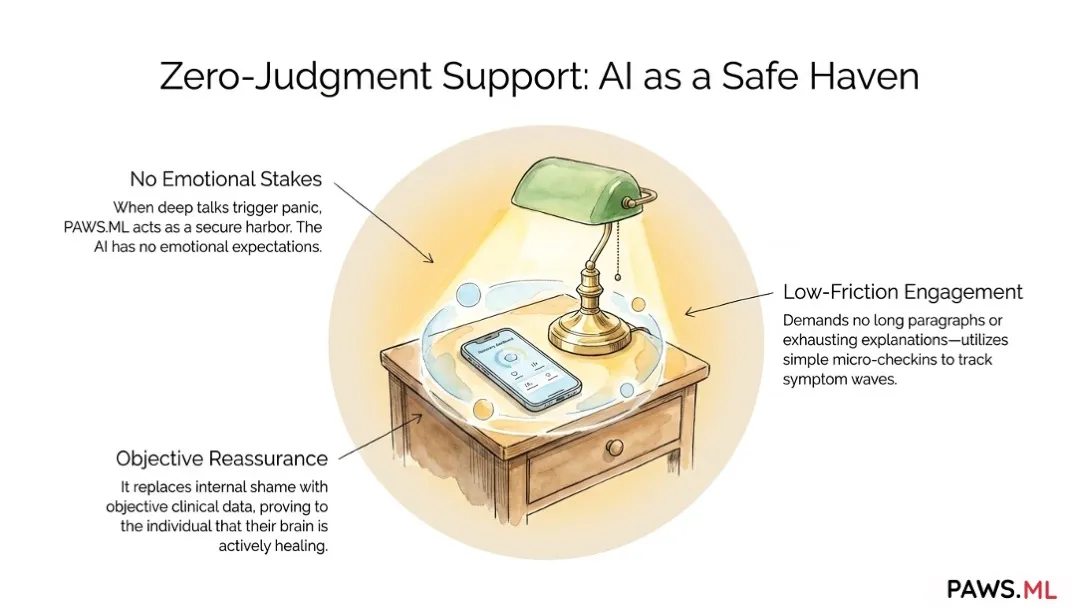
For someone consumed by guilt, an AI companion provides a completely safe space. The AI will never gasp, look disappointed, or say, “I told you so.” It holds zero emotional expectations. A user can freely admit to severe depression, intense cravings, or dark thoughts without fear of ruining a relationship or being judged. -
Minimal cognitive effort
PAWS ML does not demand long paragraphs or emotional articulation. Understanding that the brain lacks the energy to formulate feelings, the AI interacts through simple micro-checkins, visual patterns, and symptom tracking. With just a few taps, the system registers: “Anxiety wave active today.” The AI translates vague, terrifying discomfort into clear metrics, restoring a sense of personal control. -
Gentle transition to professional care
While AI cannot replace human warmth, it builds the necessary foundation for it. When the user recovers enough cognitive energy and feels ready, PAWS ML helps connect them with trusted clinical professionals. Crucially, the user won’t have to face the stress of repeating their painful story—with their permission, the AI provides the clinician with an objective summary of their symptom dynamics so care begins with total understanding.
Repairing the hardware: safe neuro-restoration without heavy pharma
Psychological encouragement is vital, but you cannot talk a depleted neurotransmitter receptor into functioning. If a car has a ruptured fuel line, polishing the exterior will not make it run—you must repair the physical hardware.
PAWS is a biological malfunction. The brain experiences a “glutamate storm” (nervous system over-excitation) while dopamine reserves are depleted. To restore equilibrium, the brain requires biological building blocks.
PAWS ML takes a modern approach to neuro-optimization through targeted, non-addictive nutraceuticals:
- 🛡️ 0% new dependency risk: We strictly exclude addictive prescription drugs, heavy tranquilizers, or habit-forming sedatives. The AI recommends legal, safe nutraceuticals—specific amino acid precursors, targeted vitamins, minerals, and gentle plant-based adaptogens.
- 📊 24/7 Safety tracking: PAWS ML continuously analyzes how you feel, checks supplement synergy, cross-references active diets, and ensures no adverse interactions occur.
- 🔄 Rebuilding through the body: Beyond supplements, the AI gently guides sleep hygiene, hydration, and light activity without pressure or rigid deadlines, helping the nervous system regain baseline stability step by step.
Reconnecting the family
If you want to help a loved one who has pulled away, explore our specialized guides:
- Read practical, actionable steps for partners and parents in our guide on supporting a loved one through post-acute recovery).
- If your loved one refuses to talk, learn more about our non-invasive approach to anonymous AI support during PAWS).
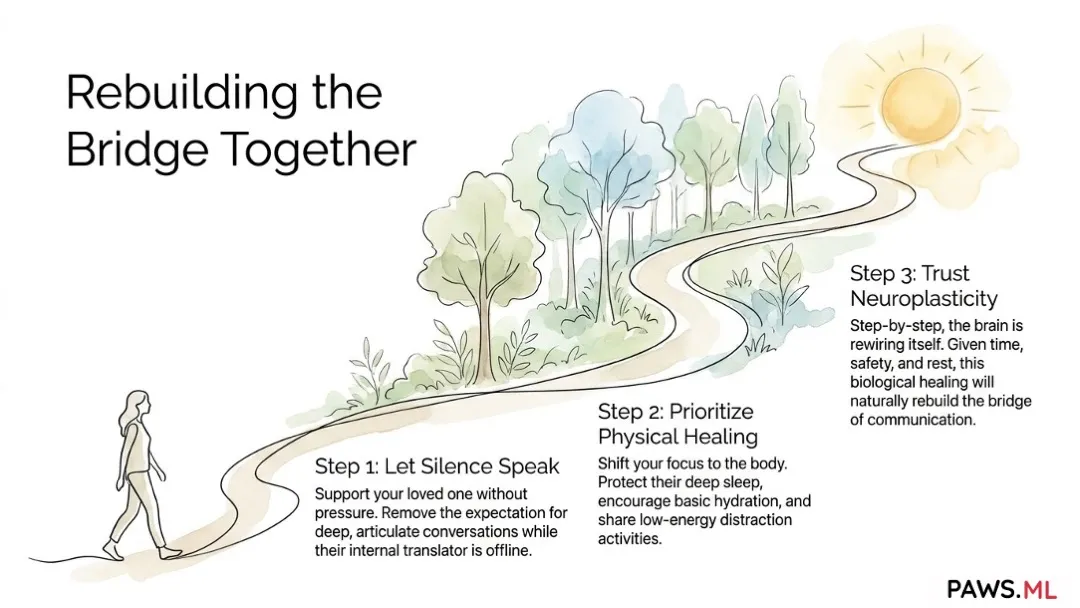
Give your loved one time and the right tools. PAWS is a temporary phase, and the human brain possesses remarkable neuroplasticity. It will heal when given the proper biological support.
And if you are reading this while enduring the silence yourself: please share this article with your family. You don’t have to explain anything—just send them the link. Let this article speak for you while you focus your energy on healing.
👉 Get started with PAWS ML for private, 24/7 recovery tracking)
Managing symptoms of Protracted withdrawal syndrome (PAWS) takes time and evidence-based care. Explore how our AI assistant supports neuro-restoration on our homepage.