PAWS timeline: How long does post-acute withdrawal last?
The real PAWS timeline: How long does post-acute withdrawal actually last?
You’ve been clean for a few months. You look at the calendar, expecting to feel the vibrant energy and mental clarity you were promised. Instead, you are hit with a sudden panic attack, crippling insomnia, and a brain fog so thick you can barely focus on work.
You might be asking yourself in despair: “Why do I still feel so awful? Am I permanently broken? How long does PAWS last?”
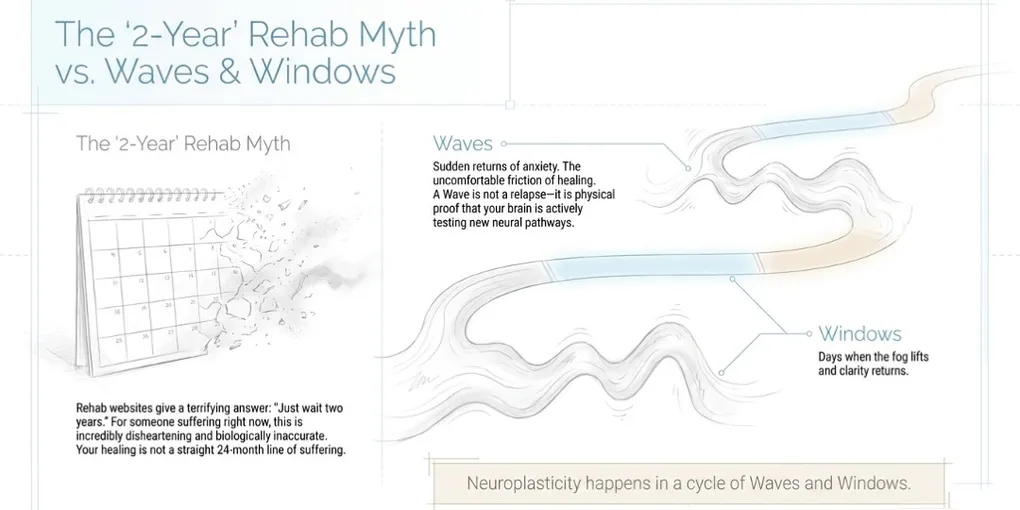
When you search for a post acute withdrawal syndrome timeline online, most rehab websites will give you a terrifying and vague answer: “It lasts anywhere from 6 to 24 months.” For someone suffering right now, being told to “just wait two years” is incredibly disheartening.
But here is the truth: your brain is not permanently broken. You are simply in the middle of a massive neurochemical reconstruction. Let’s break down that scary 24-month window into manageable phases, so you know exactly what to expect, why your healing isn’t a straight line, and how to safely track your real progress.
Why your PAWS timeline isn’t a straight line (waves and windows)
The biggest mistake people make in recovery is expecting to feel 1% better every single day. Brains do not heal linearly. Neuroplasticity—the process of growing new receptors and rewiring synapses—happens in a cycle known as the waves and windows timeline.
- Windows: These are days, or even weeks, where the brain fog lifts. You feel hopeful, your sleep improves, and you think, “I’m finally cured!”
- Waves: Suddenly, for absolutely no apparent reason, severe anxiety, depression, and physical pain come crashing back.
When a “Wave” hits, your brain will lie to you. It will tell you that you are back to square one or that you are developing a new mental illness. You are not. A wave is actually physical evidence that your brain is actively testing new neural pathways. It is the uncomfortable friction of healing.
The standard PAWS timeline: A phase-by-phase breakdown
While every brain is unique, neurobiology provides a general roadmap for how neurotransmitters stabilize over time.
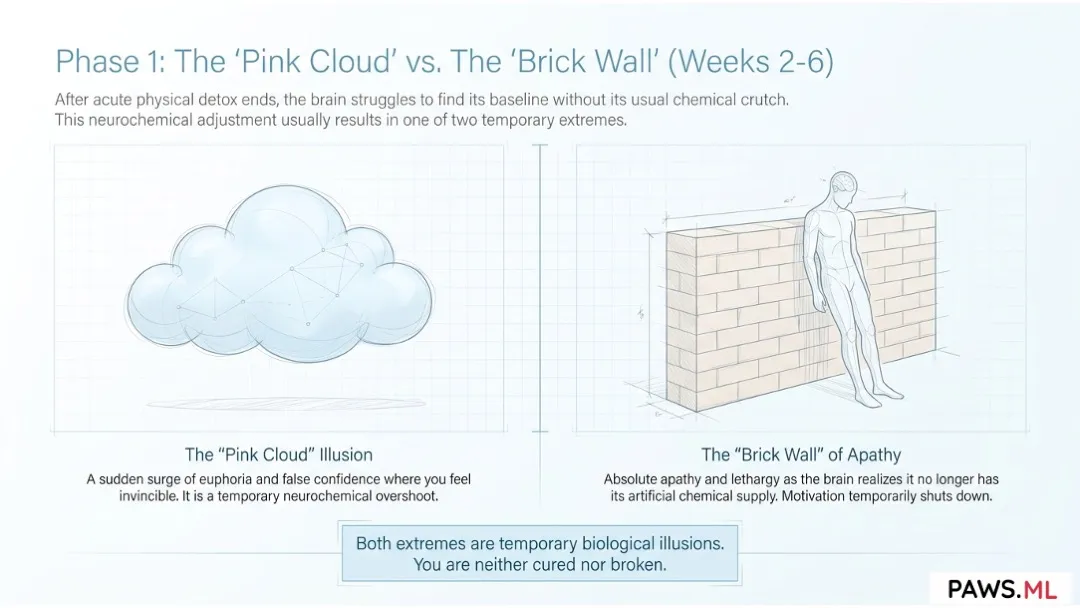
Phase 1: The “honeymoon” or “the wall” (weeks 2 to 6)
After acute physical detox ends, people usually experience one of two extremes. Some experience the “Pink Cloud”—a surge of euphoria and false confidence where they feel invincible. Others hit a brick wall of absolute apathy and lethargy as the brain realizes it no longer has its artificial chemical supply.
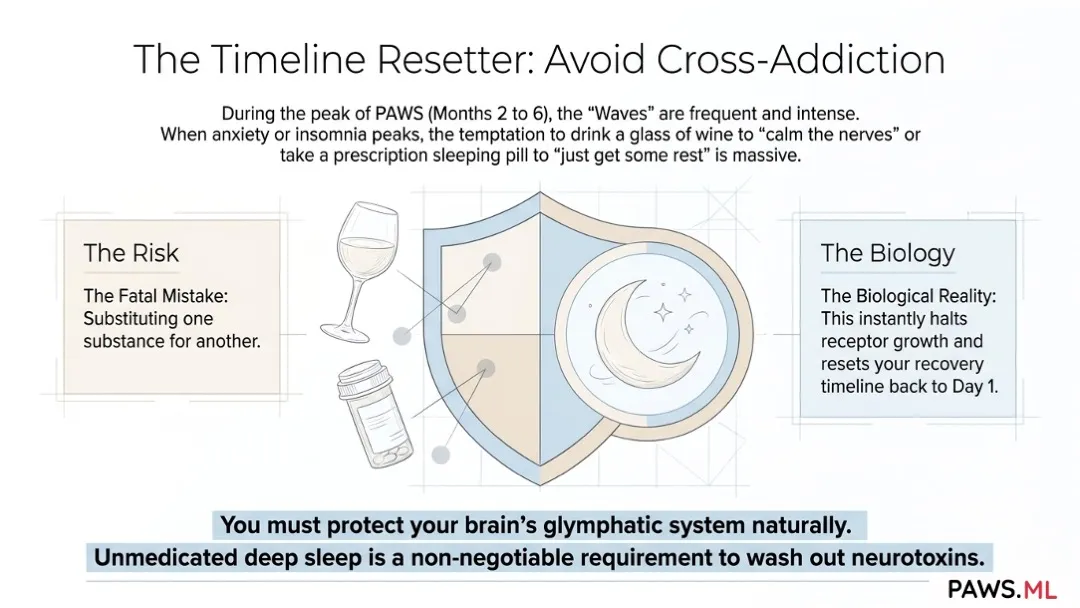
Phase 2: The peak of PAWS (months 2 to 6)
This is typically the most grueling phase of recovery. The “Waves” are frequent and intense. If you are recovering from alcohol or sedatives, your brain is experiencing a Glutamate Storm (too much excitatory chemical, too little calming GABA). This manifests as random panic attacks, muscle twitching, and profound insomnia. It is during this phase that the risk of relapse or cross-addiction is highest.
Phase 3: The turning point (months 6 to 12)
As you cross the half-year mark, you will notice a definitive shift. The “Windows” of feeling normal become much longer, spanning several weeks. The “Waves” still happen, but they are shorter and less intense. Your short-term memory improves, the brain fog thins out, and your sleep architecture begins to normalize.
Why these averages hide your true recovery path
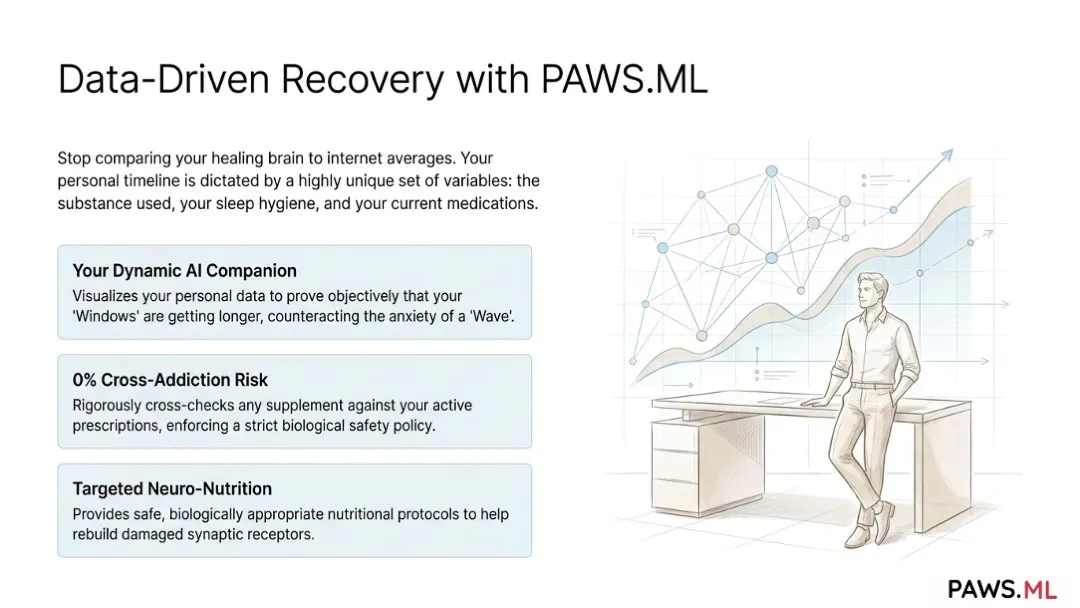
The timeline above is a statistical average. But looking at generic charts on Google or comparing yourself to strangers on Reddit can sometimes do more harm than good. If you are at Month 7 and still experiencing severe anxiety, you might panic, thinking: “I should be in Phase 3 by now. Something is permanently wrong with me.”
The truth is, your personal timeline is dictated by a highly unique set of variables:
- What you stopped using: Benzodiazepine recovery often takes significantly longer and has more physical symptoms than stimulant recovery.
- Your current medications: Are you currently taking blood pressure pills, SSRIs, or prescription sleep aids? These can mask, mimic, or alter your PAWS symptoms. Blindly taking supplements you read about online can cause dangerous drug interactions.
- How your body responds: What speeds up recovery for one person might trigger a severe “Wave” for you.
A static article cannot predict when your next Wave will hit or tell you which safe neuro-supplements fit your specific, current chemistry.
That’s why we created PAWS.ML — your personal, dynamic AI recovery companion designed to navigate the chaos of neuroplasticity:
- 📉 Symptom & Timeline Tracker: It monitors your daily progress to build your actual timeline. It visualizes your data to prove that your Windows are getting longer, even when your brain tries to convince you otherwise.
- 🛡️ Pharmacology Agent: Rigorously cross-checks any supplement or strategy against your current prescription medications to prevent dangerous interactions.
- 💊 Safe Additions Only: Recommends targeted amino acids and neuro-support with a strict, non-negotiable 0% cross-addiction risk policy.
- 💬 AI Coordinator: Remembers your unique history, adapts to your changing timeline, and provides evidence-based reassurance when a Wave hits.
Stop comparing your healing brain to internet averages. Let an intelligent, secure system build and track your true roadmap.
👉 Build your personal, safe recovery timeline with PAWS.ML)
Phase 4: Late-stage PAWS symptoms (months 12 to 24+)
As you enter your second year of sobriety, you are largely out of the woods. However, late stage PAWS symptoms can occasionally pop up. These rare “Waves” are almost always triggered by extreme external stress (a job loss, a breakup, or a severe physical illness). Your nervous system is still slightly hypersensitive, but you now have the tools to handle it. By the 24-month mark, MRI studies show that the volume of gray and white matter in the brain has significantly recovered. Your executive functions are restored.
3 factors that dramatically change your PAWS timeline
If you want to support your brain and avoid resetting the clock, pay attention to these three variables:
Factor 1: Cross-addiction (the timeline resetter)
When the anxiety of Phase 2 peaks, the temptation to drink a glass of wine to “calm the nerves” or take a prescription sleeping pill to “just get some rest” is massive. This is a fatal mistake. Your brain is desperately looking for a chemical crutch. Substituting one substance for another instantly halts receptor growth and resets your recovery timeline to Day 1.
Factor 2: Your substance profile
The PAWS timeline by substance varies wildly. GABAergic drugs (like alcohol and benzodiazepines) cause profound structural changes to the central nervous system, leading to longer, more physically uncomfortable timelines. Stimulants (like cocaine or amphetamines) heavily deplete dopamine, meaning the timeline is heavily characterized by deep depression and lethargy rather than physical panic.
Factor 3: Sleep & the glymphatic system
Your brain physically washes out neurotoxins and repairs synapses during the deep stages of sleep via the glymphatic system. If you do not prioritize natural sleep hygiene (e.g., zero screen time before bed, cold room, magnesium salt baths) or if you rely on prescription sleep aids that block deep REM sleep, your brain cannot heal effectively.
Summary & when to seek doctor’s help
PAWS is a marathon, not a sprint. The timeline is long and frustrating, but neuroplasticity guarantees that if you stay the course, your brain will find its balance again.
⚠️ Medical Safety Warning: While PAWS.ML and at-home tracking are incredible tools for managing the long-term waves of recovery, they do not replace emergency medical care. If your symptoms are not coming in “waves” but are continuously worsening, or if you experience:
- Severe seizures or convulsions;
- Hallucinations, delirium, or extreme paranoia;
- Active, intrusive suicidal thoughts with an intent to act;
Do not wait. Call 911, your local emergency number, or go to the nearest Emergency Room immediately. Acute psychiatric or neurological crises require temporary, professionally monitored medical intervention. Safety always comes first.
If you are currently experiencing the challenges of Prolonged withdrawal syndrome, return to our main page to explore how our AI recovery assistant can help stabilize your neurochemistry.